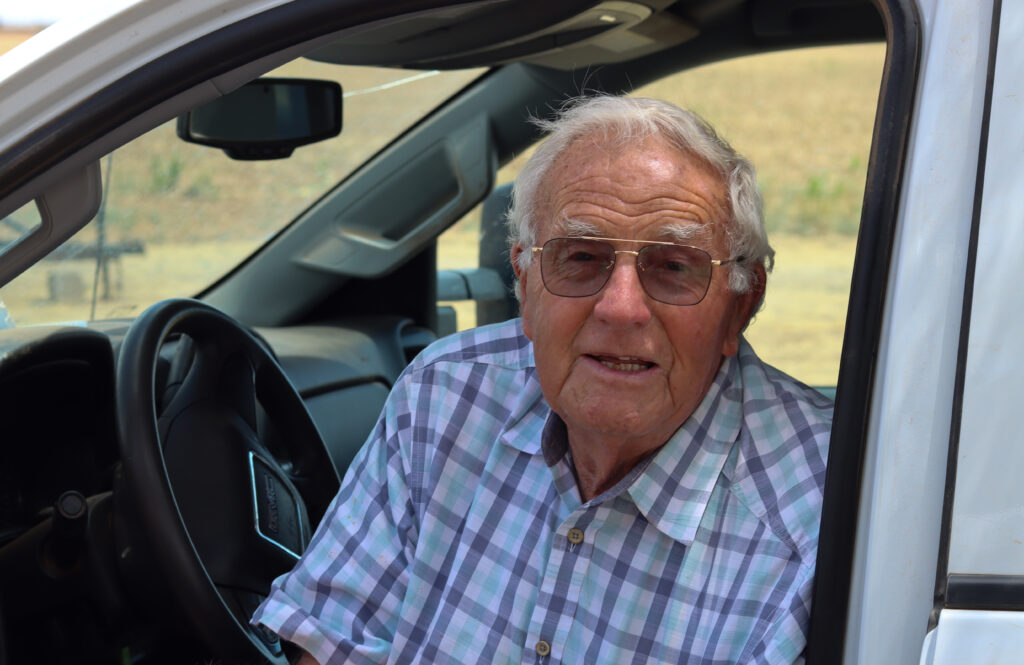
This is Bub Eldredge. He raises crops and cattle near McAdoo, Texas, taking care of a thousand acres, mostly on his own. He’s 83 years old. So, what did you get done today, city slicker?
But that’s my question, not his, because he’s not the kind to talk that way. I met Mr. Eldredge earlier this week (August ’22). I was introduced to him by the Guzman brothers. He showed me some of his antique farm implements, including this horse-drawn planter.
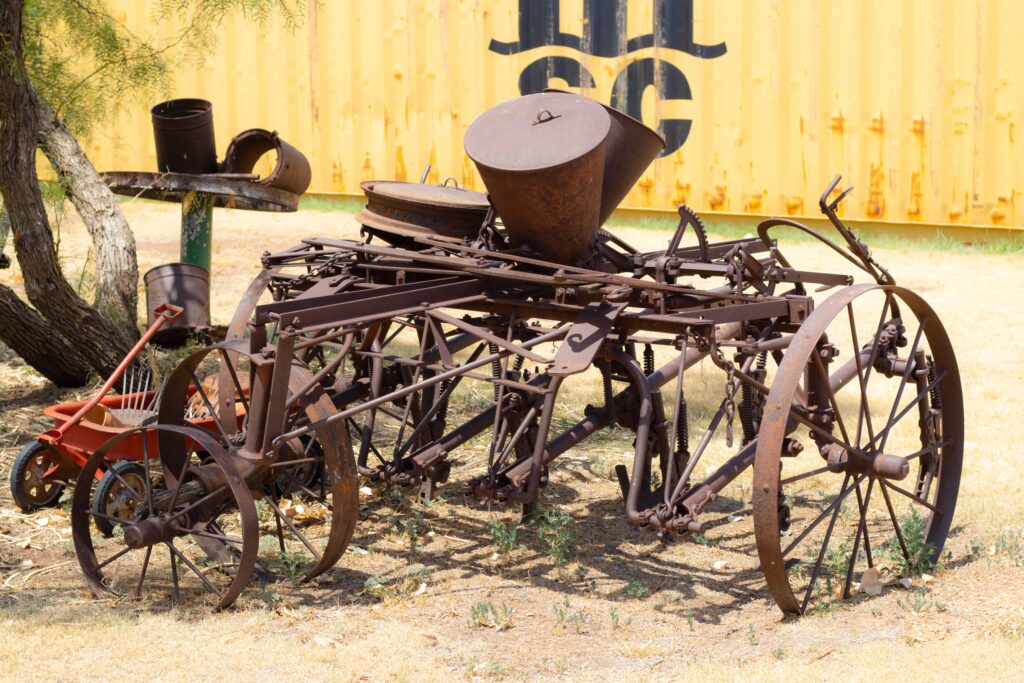
The horse or mule that’s pulling it, he explained, would sway from side to side as it walked. So the men operating it, were constantly having to steer as well, in order to plant straight rows. We marveled at the amount of work these men were able to accomplish in those days, using only the power of horses and mules.
For those of us who work mostly from a desk, what he is accomplishing every day, at 83, is rather impressive as well. I told him so. He didn’t say anything, but smiled in acknowledgement.
As you might imagine, there’s a whole lot more to tell about Mr. Eldredge–as rancher, farmer, school principal, basketball coach, and also as former teacher of the aforementioned Guzman brothers, back when they were in school.
Decades later, the good-natured jabs continue. Bub: “Like I always told Luis, if you’d have quit chasing the girls around, you could’ve made something of yourself.” Luis: “And if you’d have been a better teacher, I could’ve been a doctor!” And so were re-told, for my benefit this time, these well-rehearsed lines of attack and counter-attack.
“You wanna hear some o’ that junk?”
[August, ’25] I finally got a chance to get back out to visit with Bub. I’m embarrassed at how long it took me to get that done. Graciously, Bub didn’t miss a beat, and offered to show me around. I drove in the night before from Dallas. I brought kolaches for breakfast, and we sat in his pickup before heading out. He asked where we might pick up our conversation. Maybe your early days in McAdoo? I suggested.
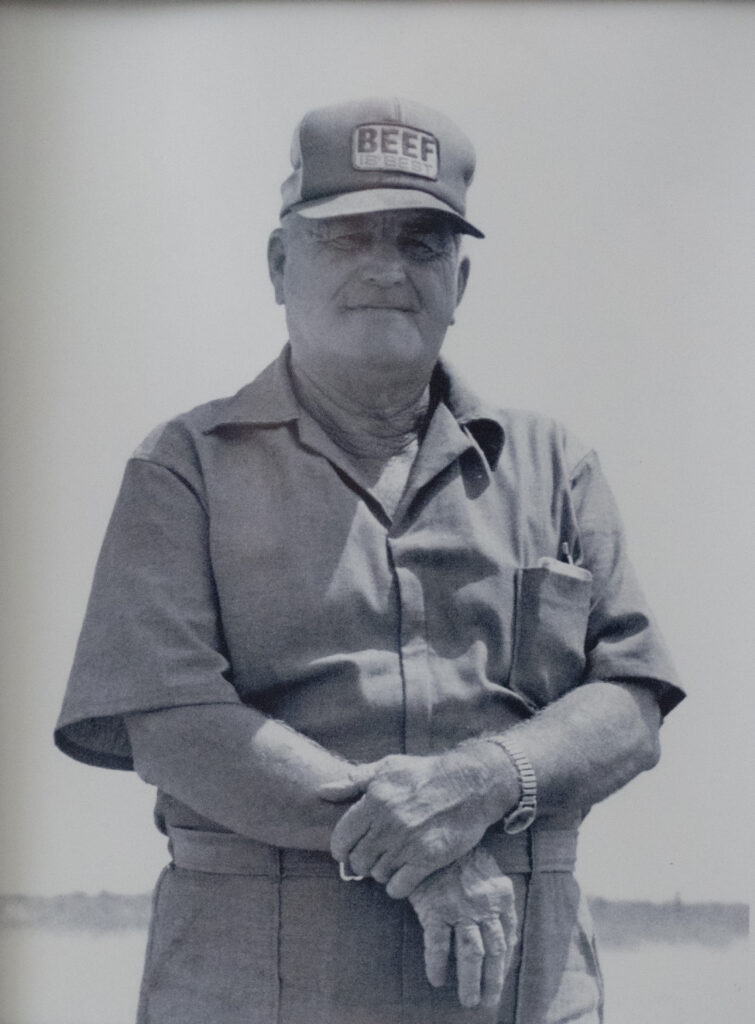
You wanna hear some o’ that junk? My dad, they owned the filling station right down the road from here. And probably, I was born in ’38. And so when I was six years, I guess six years old, he moved, he bought the farm behind the station. And they moved up to that farm, an old house that had been there 100 years. And they put paper on the wall and you could see the paper wind blowing. It was cold…that was a hard time…
And no electricity. He had a wind charger at the filling station. He moved up there and had about 10 batteries in the back porch. And that’s, they had one little light hanging down in the school, I mean in the house. No, no restrooms, outside toilet.
No sugar, you know, of course my Dad had the filling station, he got sugar there. That was the only filling station from here to there. You know, people knockin’ on the door and wantin’ to get gas, and you never knew who they’s going to be or who they wasn’t going to be. [See, it’s the same thing now. Now I’m bothering you in the same way that those people used to bother your Dad. You never know who’s going to show up on your door.] Yeah, but anyway, they moved in that house up there, just they hadn’t, barely had a dime to live on, you know.
Rich in other ways
They didn’t have much money, but in other ways, they had plenty.
They had the cattle. They fed cattle out, that’s how he bought that farm. They milked cows. And they set those cream cans out on the dirt road, and they come by and pick ’em up. [Raw milk.] No, I think we had that separator. We had to…and we separated, and we sold the cream. [Did you make the butter and stuff too at home?] Yeah, we put it in a [a churn] a jar. We shook it. We didn’t have no, oh we had to shake it to make it. [You were the churn] Yeah.
Of course, my folks, you know, then everybody had a…they built a house for little chicks. They’d order about 200 of those. And they come in the mail. [200. Yeah.] And then they had that. And then they had another for hen [hen house.] For the hens, yeah. [But when you got 200, you got boys and girls both.] Well then I don’t think they, you just got what you got. [You got what you got. A straight run.] A straight run. [Yeah.] Because I don’t think they had any way to…to separate ’em. [Yeah. I got four now.] You got four? [Four hens.] Oh, really? They give you enough? [Yeah, that’s enough. Yeah. Three eggs a day, pretty much. Yeah. That’s enough. Anyway, so yeah. You get ’em, get the chicks in the mail….]
Yeah, that’s the way you order ’em, the post office, you know, they deliver ’em to you. Well, we, what we did, when they got bigger, then they’re called fryers. But, we had some kin folks, they’d come and we’d catch, ring their…ring their necks. Yeah. And then they’d dress them.
Baseballs and cotton bolls
In those days, and still for the most part today, property was divided into 160-acre parcels, or “quarter sections,” in the language of the old survey system, where a full “section” was one square mile, or 640 acres. With the sides of each quarter section measuring a half-mile, neighbors were on average about that same distance apart.
The place that we bought, the Gollihars farmed it with mules. He had a house on every 160 acres and those hands farmed that land. I don’t know how they did it. Then, we didn’t have cars. So our place up here, and the neighbors are half a mile, and another half neighbor half, and another half. We’d all meet in the pasture and play baseball. [Nice. I bet grounders were a bummer.] Yeah. So that’s the way we did that back there when we were kids, you know. That’s the way we played.
The Van de Leer place over there, he brought cotton to the gin up with his mules. They turned school out two weeks for cotton pullin’. And I wasn’t very good, so they made me do the weighin’. And they bring it up there, and you had to, you weighed it. And up here we had a garage. We had about 10 people stay in it, and then another shack, they had about 10 there, and about 20 out at the barn he fixed. And then we had those…you know, weigh ’em. And they didn’t want any green bolls. Some of ’em wanted to put green bolls; they weigh more. So you had to watch all that.
School days
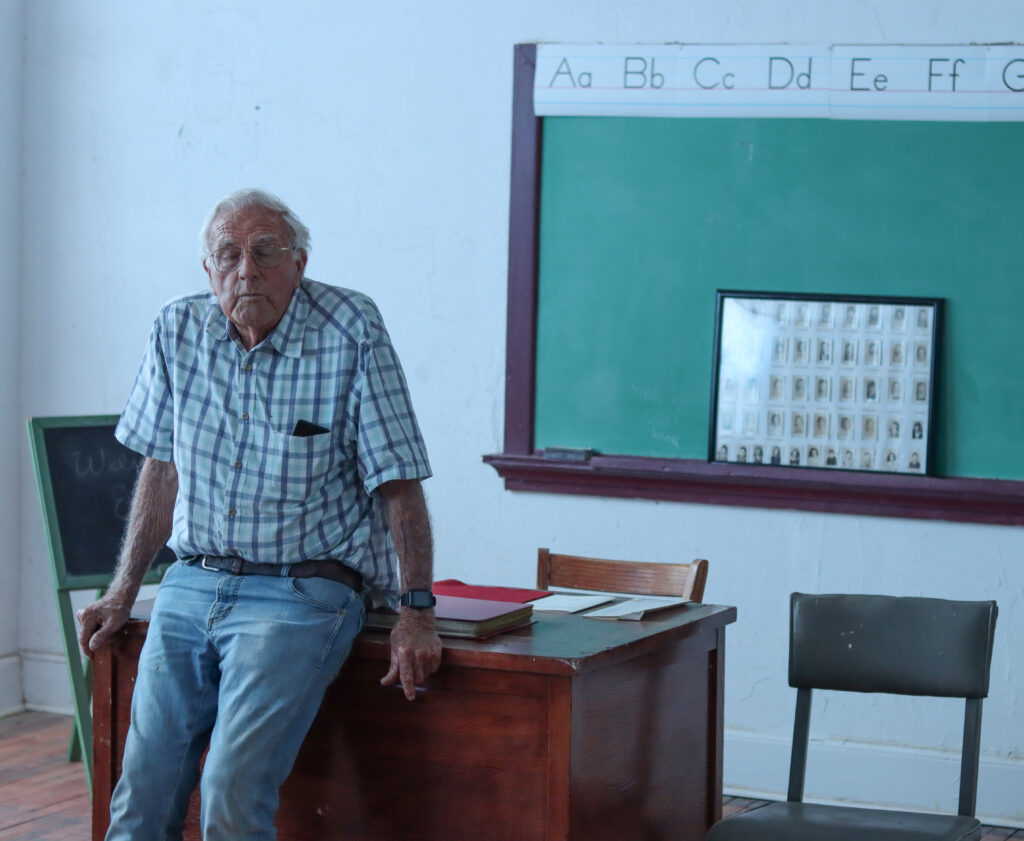
Bub started school in the fall of 1945, just as WWII was coming to an end. “They put me on the bus. And I didn’t want to go, ’cause I’d have rather stayed here with the cows” he told me. “I went to school 12 years at McAdoo, up through the 12th grade.”

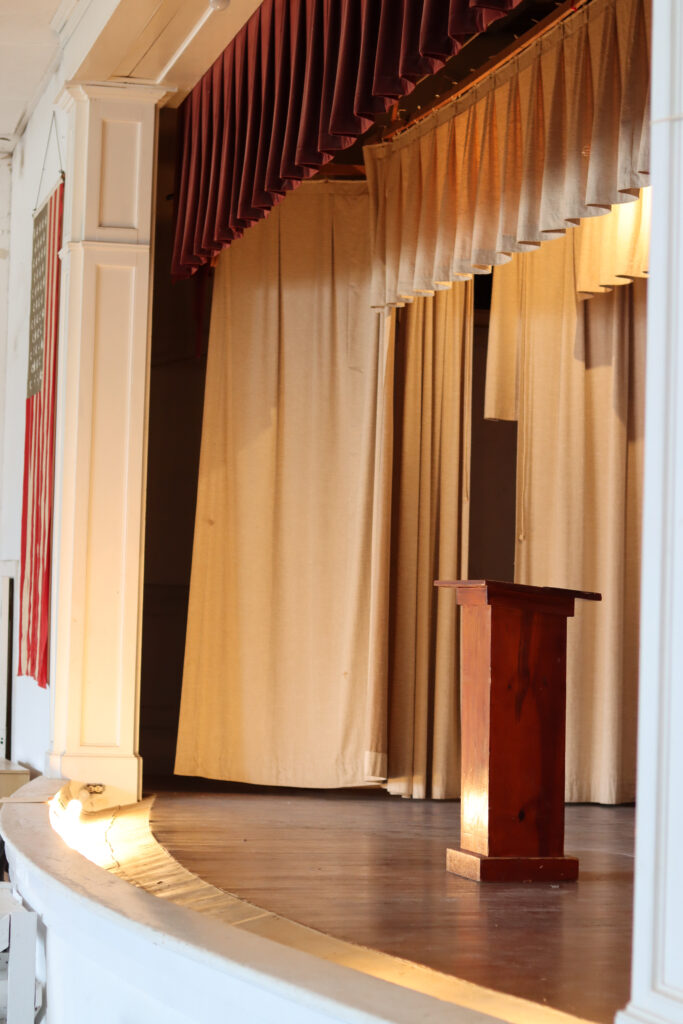
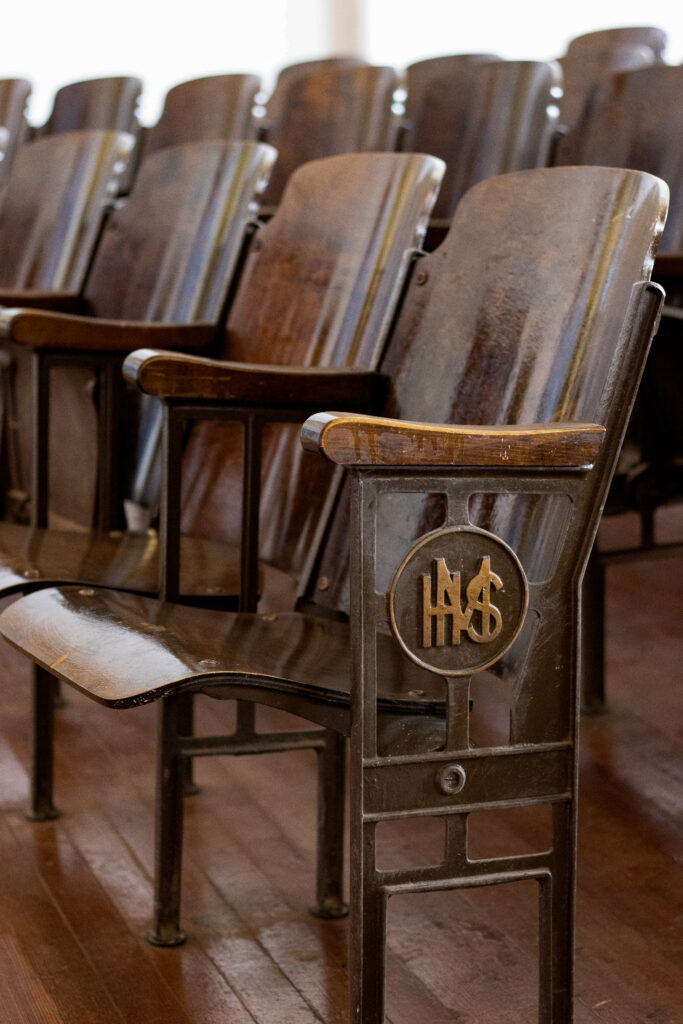
The first school in McAdoo was established in 1908, predating even the official formation of the town in 1915.[1]For more information on McAdoo schools and Dickens county, please refer to the Dickens County Historical Commission. The McAdoo school where Bub attended, and his father Raymond Eldredge before him (Class of 1932) was built in 1928. It continued in operation until the closure of the school district in 1985, one of several consolidations in Texas during the mid-1980s. The main school building itself, however, thanks to local volunteers and donors, is immaculately preserved.[2]For more information, contact the McAdoo School Historical Society, at P.O. Box 86, McAdoo, TX, 79243 Bub gave me the full tour.
The desks, the books, the auditorium, all just as they were–silent now but somehow expectant, as if the bell might ring any moment, students bursting in. Bub told a few stories of his school days, standing in the very same classroom where they’d unfolded decades ago. Were these remembrances he was sharing? Or echoes from the past?
Basketball
When you drive into McAdoo, there’s a welcome sign, standing prominently on the northeast corner of FM 193 and FM 264.
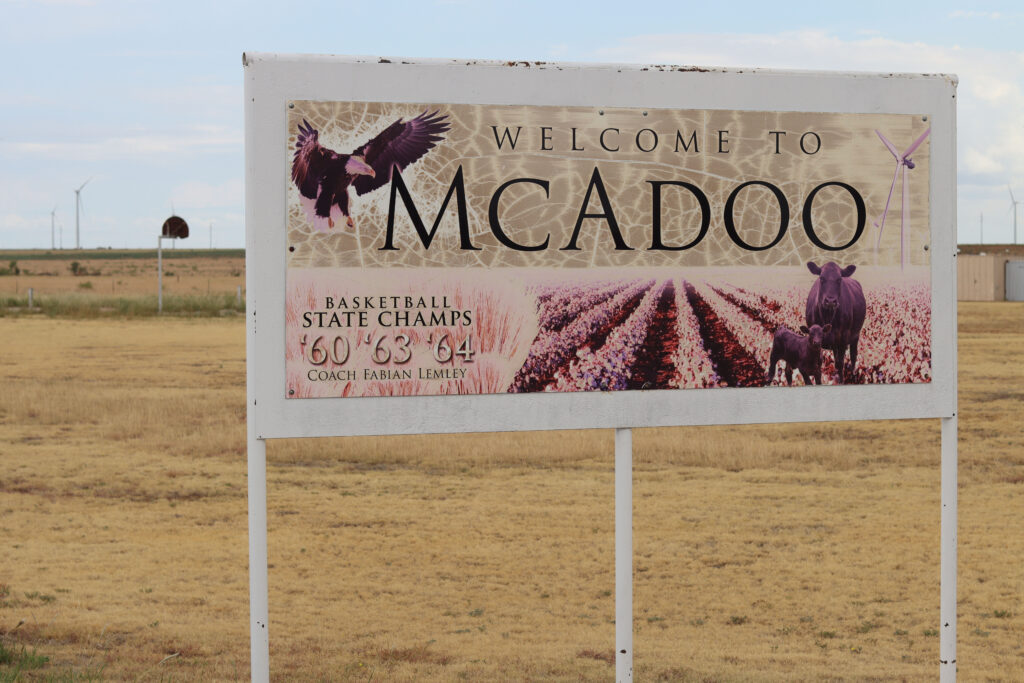
This sign informs all comers that three state basketball championships were won here, under Coach Fabian Lemley. Three championships in five years–that’s pretty impressive. Later I did some research to find that in the 100+ year history of UIL Texas high school basketball, less than ten programs have matched or exceeded McAdoo’s 3-in-5 performance. [3]High schools that have matched or exceeded McAdoo’s 3-in-5 performance include: Bowie/Tucker, Buna, Kimball, Kountze, Krum, Morton, Nazareth, Port Arthur Lincoln, and Snook. Sources: UIL State … Continue reading.
When I saw that sign on my first trip to McAdoo back in ’22, I remember wondering if there was anyone still around who could tell me about about it. As serendipity would have it, I learned during my most-recent trip that one of the key players (literally) in that past success–first as a player, and later as coach–was none other than: Mr. Bub Eldredge.
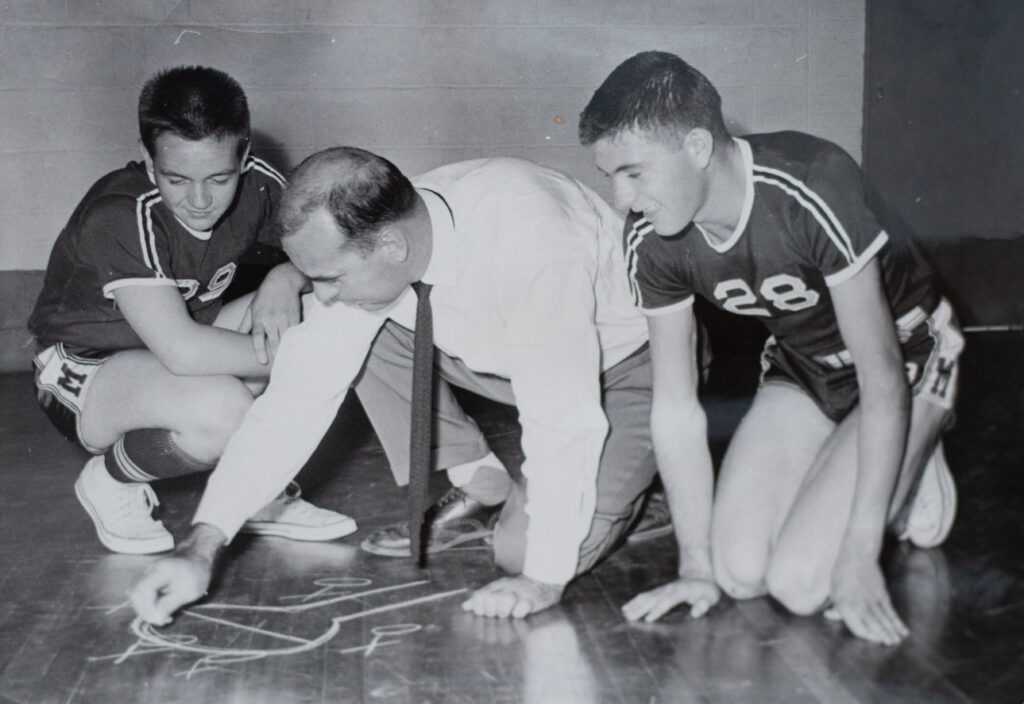
Started basketball, you know, in McAdoo, we started in the fifth and sixth grade. We played on Monday and Thursday. You wonder how we finally got good, you know? That’s all we had to do.
So then when I was in eighth grade up here, one of the basketball coaches—that’s why I was so smart—he took me to the gym, in my off period and we played basketball. Supposed to have been studyin’ you know.
Then you could play with the JV team. That was legal then. You couldn’t play with varsity, but I played with the JV.
“Bub Eldredge went wild…”
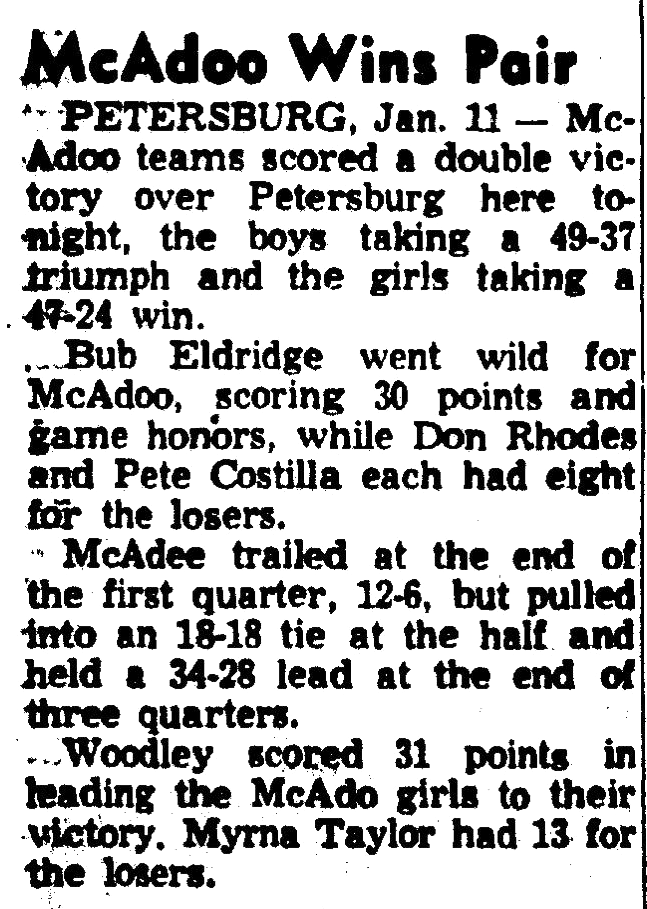
From playing with the high school JV team as an 8th grader, Bub went on to become one of the leading scorers for McAdoo and all of Districts 9 & 10. In small West Texas towns of the era, and for some even today, high school sports were at the center of community life. And the local papers covered them with a certain, shall we say, exuberance. In honor then, of the great sportswriters of 1950s Texas,[4]For a deeper dive into the glorious tradition of Texas sports writing, the logical starting point is Blackie Sherrod—16-time Texas Sportswriter of the Year and, by wide consensus, the dean of the … Continue reading I give you this exuberant account of Bub’s hardwood exploits:
In Bub’s senior campaign of 1956-57, the high-flying McAdoo Eagles notched 24 victories against a mere five reverses, claiming first-place tournament silverware at Girard, Patton Springs, and the Floydada Invitational, where the sharpshooting Eldredge copped All-Tournament laurels. In a January ’57 tilt against Petersburg, “Bub Eldredge went wild for McAdoo, scoring 30 points and game honors” in a scintillating showcase of roundball wizardry. In the girls’ contest, McAdoo’s Woodley flipped in an equally-impressive 31 in their victory. Members of that year’s crack men’s squad included Maybron (Bub) Eldredge, Neal Allen, Curry Brantley, Benny Brown, Tom Coffey, Neal Crosby, Van Cypert, Earl Hardy (manager), V.B. Scott, Kenneth Wallace, Richard Ward, Foy Westfall, and Dick Woolley–an iron-willed brotherhood of hard-nosed hoopsters, guided by the rock-steady hand of Coach Fabian Lemley.
College Ball and a Conference Championship
My math teacher carried me to Clarendon Junior College to try out for basketball. So he carried three of us down there and they gave me a full scholarship. And they give those two boys a half scholarship. But that was in ’57, ’58 I guess, we went on over there. We won that conference, believe it or not.
[Coach] Buddy Travis. He was good. I guess we was graduated, went by and talked to him. He said, that’s why we all turned out coaches. He changed the plays nearly every week. Everything, every school we played. You know, we played Howard County, then Lubbock Christian was junior college, Frank Phillips, and, Odessa, I guess then. [And he changed the plays up every week?] Yeah. Every time. That’s why we all went to be coaches.
He told us you could make the basketball team. But said, you didn’t know about your subjects, you know, if you could pass or not. But anyway, you know, you take a few basket weaving classes, just in case. [Yeah. Help your GPA a little.] But didn’t need them.
Then from there, went to West Texas, started playing ball up there. Got hurt up there. And knocked me outta that. [What happened?] My back. I had to have it operated on. Then they took a disc out. Then, you didn’t fuse it or nothing, you know? So I got out there and come back to McAdoo.
Coach Eldredge
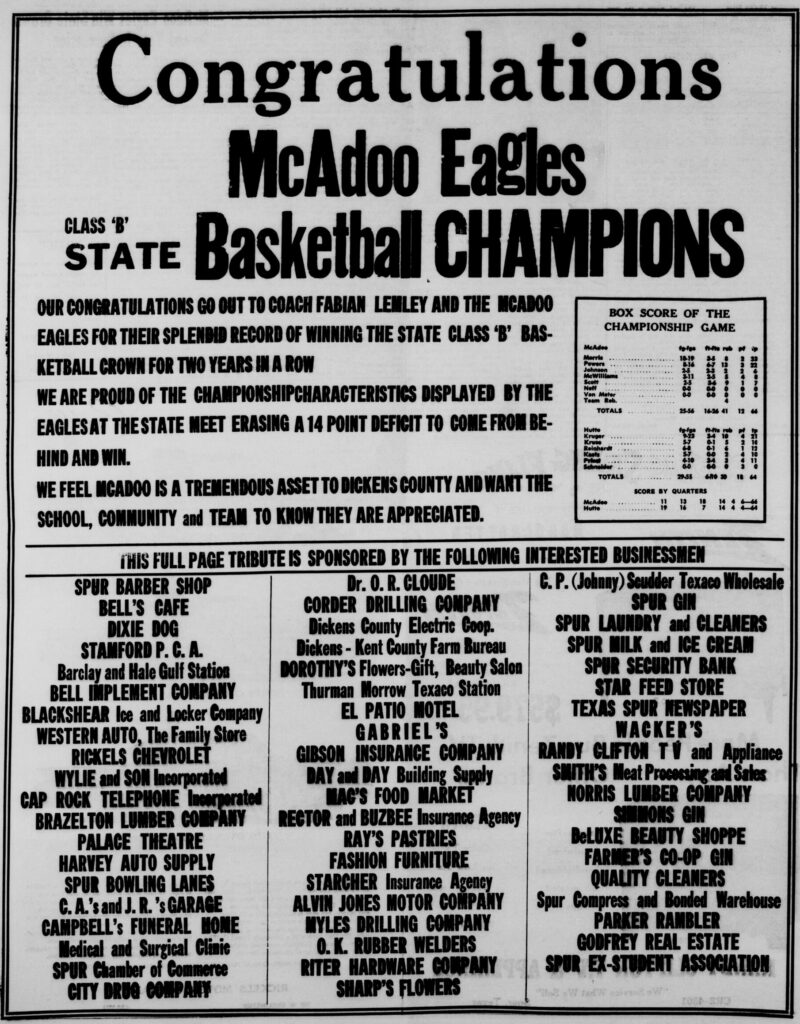
After West Texas A&M, Bub returned to McAdoo in 1961 and began coaching in 1962, as Assistant to Coach Fabian “Doc” Lemley. These were the glory days of McAdoo basketball, yet to fully dim, as the glinting trophies still attest.
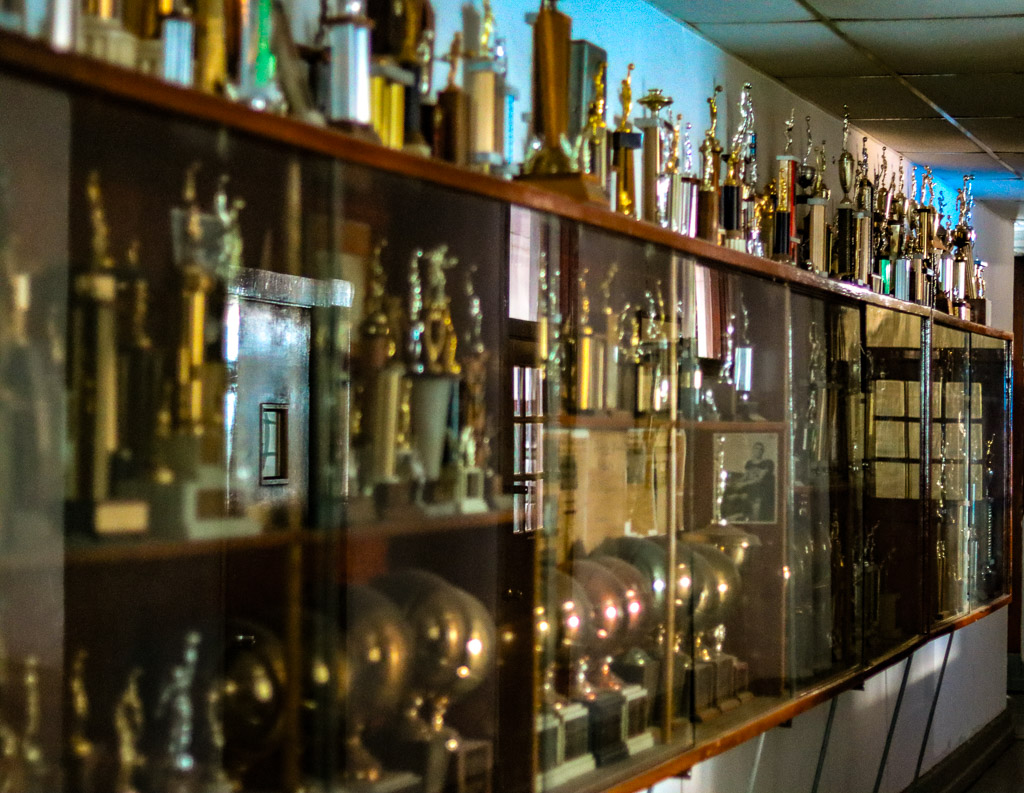
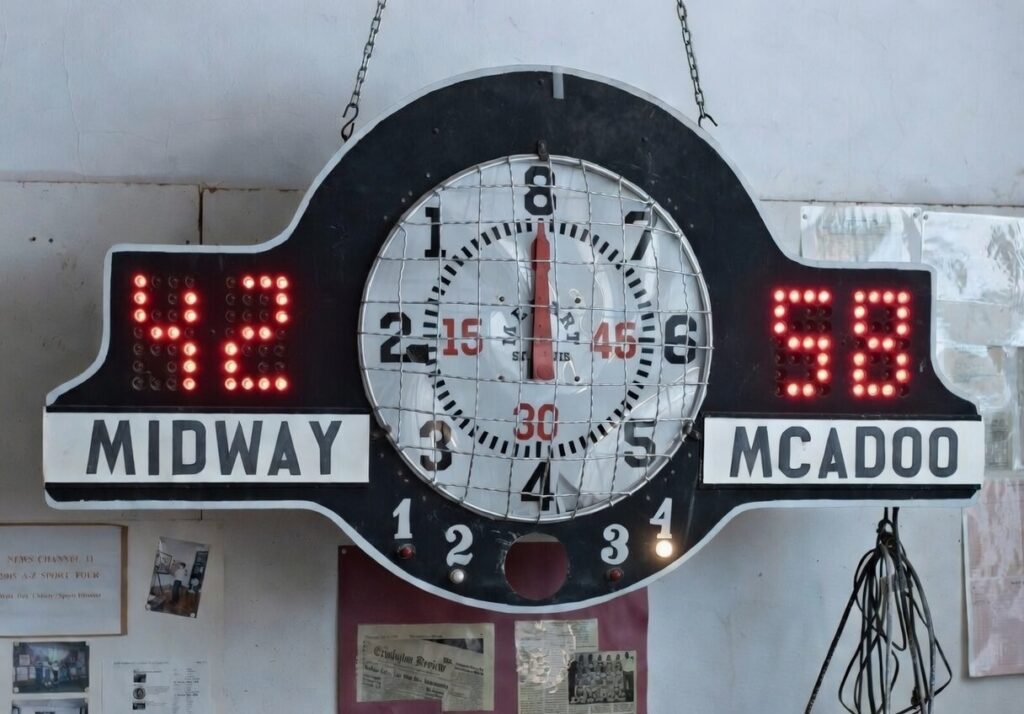
The McAdoo Eagles won Texas state championships in 1960 (d. Henrietta Midway, 58-42), ’63 (d. Nocona Prairie Valley, 53-35) and ’64 (d. Hutto in a nail-biter, 66-65).[5]KCBD story from 2005
Bub’s coaching responsibilities at McAdoo began with scouting for the 1960 championship season. “Now you just take a film and you study it, run it, you know, back and forth. We didn’t have film then. I’d go down there and watch them play, and write it on a piece of paper what you thought they were doing, you know.”
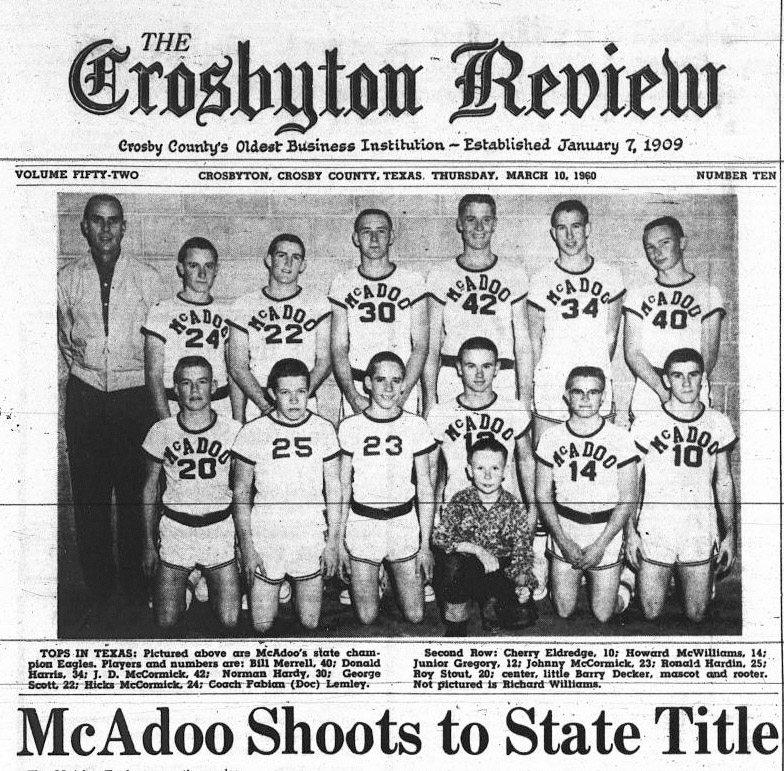
In addition to their state championship, the ’60 season also included a 43-point performance by George Scott (wearing #22 in the photo below), an incredible feat achieved decades before the 3-point line was introduced. This conference record for highest score in a tournament game, shared with John Ray Godfrey of Aspermont in 1962, still stands today, more than 60 years later.
Principal Eldredge
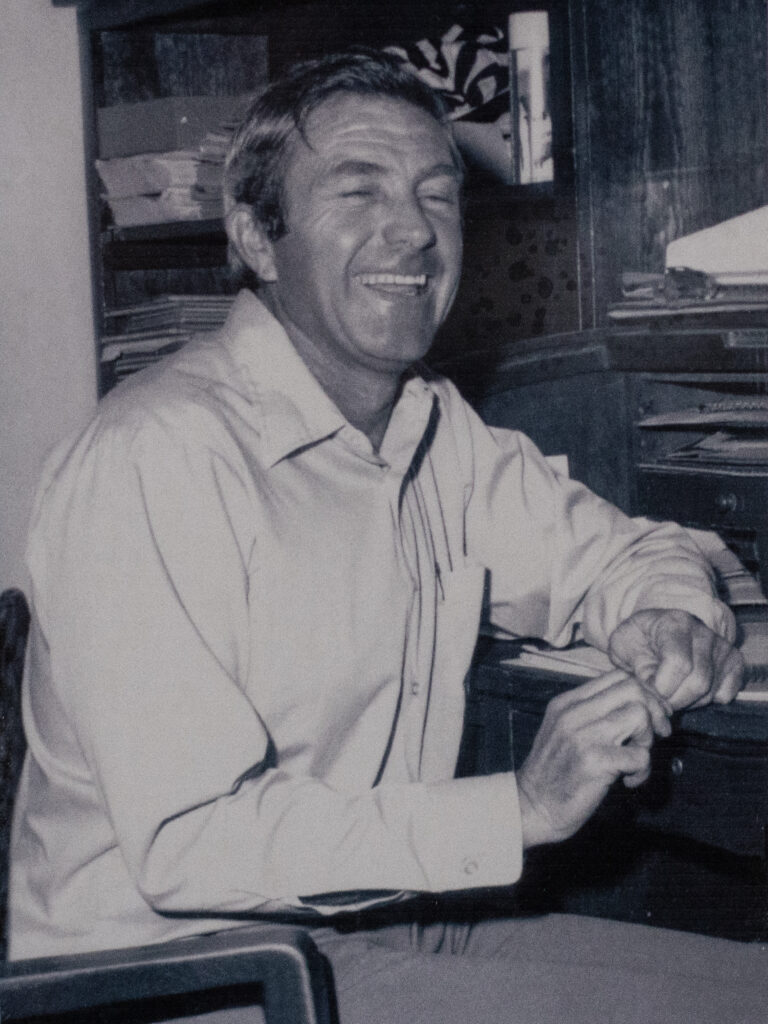
Bub would stay on at McAdoo, coaching and teaching. He was appointed principal in 1966, a post he held until the school’s closure in 1985.
Based on our interactions and the stories he tells, Bub seems to have the right temperament for being a principal–calm, patient. “Mr. E!” is how the students would call out to him, he told me. Having coached for all those years, I’d guess there’d have to have been a few flare-ups, but I’ve never seen it.
I recall our first conversation, back in ’22. We’d wrapped up for the day and I was packing up my things to return home. “When does your semester start?” he asked. (I teach at a university–that’s my ‘day job’). “Next week,” I replied. “Well,” he said, “be nice to ’em.” Not sure why but that stuck with me. Years later I still recall that advice at the beginning of each new semester–“be nice to ’em.”
“Up here at McAdoo, I taught driver’s ed. You know all the kids here, they can drive in the country time they’re 10 years old. [No kidding.] Yeah. So what we did during driver’s ed, we went around and checked my cows. So then all those kids still remember it. [That’s funny.] You know, driving the pasture, checking the water.
And on Friday, if they were pretty good, we’d go to Dickens. They had a pharmacy down there, fountain drinks, you know, and they’d save their money up and they’d, I’d make ’em buy me a drink, you know. [That’s a good deal right there.] You know, it was probably 25 cents. You know, up here at McAdoo, it was 5 cents, Coke. Popcorn was, I guess a nickel. But then if I had a date, you know, we’d take $2. To go to Crosbyton and a movie. I think it cost a quarter to get in. And 10 cents for popcorn, and 10 for a Coke, and had money left.”
Family Life
“I got married in ’70, I guess” Bub told me. “We bought this place. Four hundred acres and don’t ask me how I bought it” he said, which is West Texas gentlemanly code speak for downplaying one’s own achievements. Like with his basketball success at Clarendon College, where “believe it or not,” as he described it, they won the conference championship. Or when he told me how he and his wife Mary “accidentally scraped up two thousand” to buy their first house.
Now, you might be wondering how it was possible to buy a house–not just the down payment, but the entire purchase price–for just $2,000. I mean, this was 1970 and things were cheaper, but they certainly weren’t that cheap. So, as someone from Bub’s generation (and mine too, still) might ask: What gives?
“It’s in the middle of the road.”
To turn their acreage into a homestead, Bub and Mary needed, well, a home. As serendipity would have it, an opportunity soon presented itself.
Nearby, the Texas Highway Department (“TxDOT” since 1991) had a road-widening project underway–one of many across rural Texas in the wake of the Federal Aid Highway Act of 1956. Properties in the path of construction were bought up, and their houses scheduled for demolition–unless that is, the owner acted quickly, before the bulldozers arrived.
According to the highway department’s policy on “owner retention of improvements,” seller’s were generally allowed to buy back the structure for “salvage value”–normally 10% of the state’s purchase price–in order to move it, re-sell it or dispose of it as they wished, before demolition began.[6]The Federal Aid Highway Act of 1956, Eisenhower’s sweeping legislation that created the Interstate Highway System, triggered a cascade of road-widening and right-of-way acquisition across the … Continue reading
Bub will take it from here:
This house was a mile down the road. And they put this four lane road in. And the guy, they gave him $20,000 for it. And he could buy it back for what, 10%, or $2,000. He bought it back. And then he thought he could sell it. Then he couldn’t sell it because it had to be cut in two because it’s “L”-shaped…the house had to be cut in two, to move it. [Oh, okay] It sat right in the middle of the highway. [Oh. So, okay. So they were gonna put the road through, but the house was there] Right in the middle of the road.
And they [the state] bought the house from the guy, give him $20,000. And he bought it back for $2,000. And he thought he’d make money. But everybody couldn’t get a loan on it because the house was too old. So he come to me and he said, ‘I’ll sell it to you for $2,000, just what it cost me.’ Of course, where was $2,000 coming from? I didn’t have it. So we accidentally scraped up $2,000 and bought it.
I went to FHA. [Yeah] And I said ‘I bought a house.’ [Mm-hmm] And, uh…and I said, ‘It’s in the middle of the road.’ And I, I knew the guy, John Quattlebaum. [Okay] And he, and he said, ‘Uh, we’ll see’ [Wait, wait, wait. What…what did they say when you told him the house is in the middle of the road?] He said, ‘What are you going to do?’ I said, ‘I come to see you and get the money to move it.’ And so he, uh, it wasn’t a week later, he called me. He said, ‘I got some money for you.’ [Yeah. That’s pretty quick.]
So borrowed $6,000. [Okay] $2,000 to move it, [Right] $2,000 for foundation, [Uh-huh] $2,000 to put it together and, and run the porch on it. $6,000. [There you go…that’s a pretty good deal.] $50 a month payment. [Nice.]
That house is the one Bub and Mary still live in today. They raised their two daughters there, making additions and improvements as the family grew. The Eldredge daughters would later graduate from Texas Tech, and go on to careers in business and nursing.
The house itself, once condemned to demolition, rescued for $2,000, cut in two, hauled down a dusty road and reassembled, transformed their acreage into a homestead. For the Eldredges, and for at least one other family before the move, this house has been providing shelter from the hot and cold winds of West Texas for well over half a century. And counting.
Crosbyton Chiefettes
After the McAdoo closure, Bub had one final chapter in his teaching and coaching career, this time at nearby Crosbyton. Before his retirement in 1997, Bub spent 12 years there, coaching the Crosbyton Chiefettes girls basketball team to their first-ever tournament win.
“So, that job come open over at Crosbyton. And they’d never won a game, period, the girls–I just coached girls over there. So, we had the “Little Dribblers”[7]The Little Dribblers Bub refers to is a youth basketball program, focused on player development, and founded in nearby Levelland, in 1969. back then, so I had a pretty good bunch of kids coming up. And then [after the McAdoo closure], some of them come to Crosbyton, some of them went to Spur.
I always told them, I brought the smart ones to Crosbyton, and the…the others went to Spur. But anyway, that’s the way it happened. And we had good years over there at Crosbyton. They’d never won a tournament in their whole life, had the girls. That’s hard to believe. You know, you enter somewhere, you’re gonna win.”
Red Dirt Backroads of Dickens County
My original plan for the day had been a simple one: ask Bub to share a few stories of growing up in and around McAdoo, then take up his offer to show me around the place.
So far, the plan had worked out well. In about an hour, sitting there in Bub’s pickup, we’d traced an outline of several decades, reliving a few of the joys, hardships and achievements of his life along the way. Then it was time to move from the past, to the present and, as it would turn out, even the future, via the red dirt backroads of Dickens county.
We headed north from Bub’s house. He knew the back story for every property. “Here’s where a guy I played baseball with lived.” “This guy lives in Houston…comes here on the weekends.” “That guy right there hauled some cows for me a few years ago. From San Saba.” “This guy lives in Ruidoso. He comes out and mows. He grew up here. All the kids were my basketball players, you know? The girls live in San Antonio.” “That house right up there is probably the oldest house left in the county. I don’t know, probably 100 years, no kidding.” It was abandoned, by humans at least. Two goats remained, out front, butting heads.
Charolais and Tiger Stripes
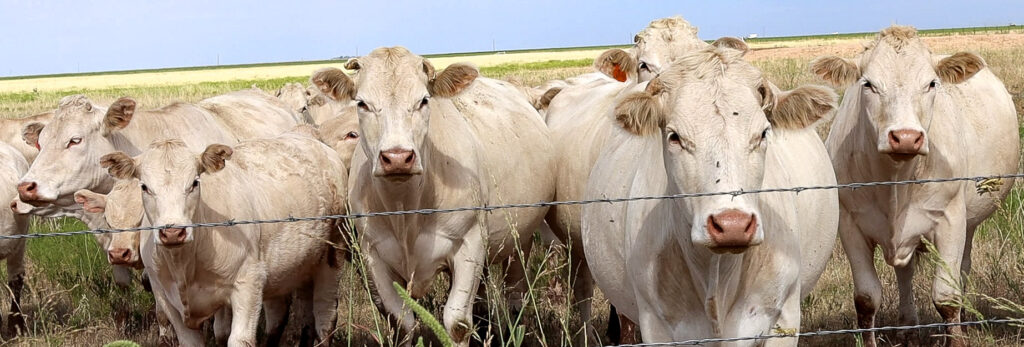
Up the road were the first group of Bub’s cattle. Beautiful, wheaten-colored Charolais, a muscular French breed, with bulls weighing 2,000 pounds or more at maturity, and cows from 1,200 to 1,600.
We stopped for a photo op. I got out first, with the camera, and they were standoffish. I waved them over. No response. I whistled at them. Still nothing. It’s amazing just how dumb these animals can make a city boy feel–I pantomime, gesticulate, grinning like a fool. They just stare. ‘What’s that guy doin’?’ I imagine them thinking. Bub calls out to them, from the truck. More staring.
“If me and you got out, I can get out and just walk around and everything. You get out with them, they’ll be gone.” Sure enough, once Bub got out, curiosity bested caution and here they came, cavorting and crowding, right up to the fence, but still nearer to him than me. OK, fine.
On leased acreage near Afton, Bub runs Tiger Stripes. We scanned the pasture but couldn’t spot them. If we’d had the feed wagon hooked up, they’d have found us, Bub told me. Cattle have excellent hearing and the wagon makes a ‘click, click’ sound as it’s towed through the pasture, dispensing hay cubes 3 pounds at a time.
“It’s got a remote control. My son-in-law fixed that. You don’t have to get out.” That last part matters, because standing between hungry cattle and a food source is never a good place to be, and the risk of getting trampled is real. Not aggression exactly–just a ton or more of animal moving toward what it wants, and you happen to be in the way.
Sometimes, though, they do get a little ornery. And Tiger Stripes in particular have a reputation for being a bit hot-blooded, which provides at least one important benefit: “Nobody’ll steal ’em. They’re too mean.” Especially when they’re with calf. A couple weeks before I visited, he’d got tangled up with one of the mama cows.
“We had our calves over here and we worked ’em. We opened the gate to put her in, and she knocked the gate against me. And this boy workin’ out here for me now picked me up, and helped me up against the fence. Yeah, it was my fault you know.”
In the scuffle, he re-aggravated an old knee knee injury, which was still bothering him weeks later. “It’s crooked as a dog’s leg,” he said, and was considering knee replacement surgery. Just recently, I spoke to him on the phone. He’d gone ahead with the surgery, and the recovery was going well.
Tough as a boot.
“This is snake country here.”
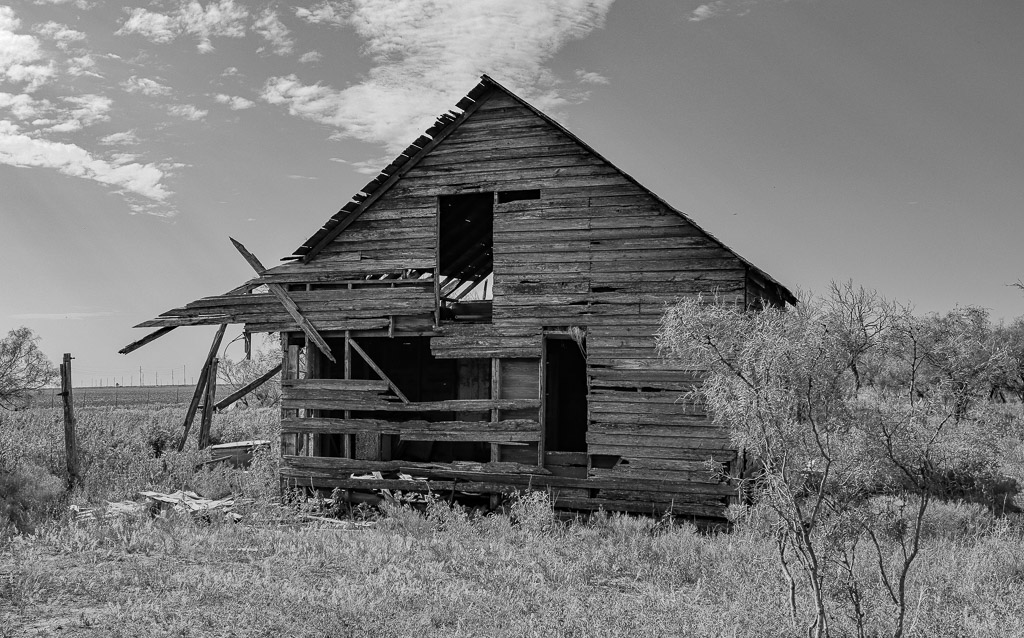
Just up the road from the cattle stands an old barn. “I’ll let you get a picture,” Bub offered, pulling to a stop, then cautioning: “Don’t get in the tall grass. This is snake country here.”
I appreciated Bub’s caution, but regarding the snakes, and unlike with the cattle, I was a bit less citified. As a youngster I’d spent time at my grandparent’s place, just inland from the central coast of California, a place called Peachy Canyon, with a climate and geography where rattlesnakes thrived.
I’d watched them dispatch several over the years, with a garden hoe or 12 gauge, including some 5-footers that ventured too close to the house or the clothesline. I’d learned, for example, that you always look behind things, for snakes that might be concealed, and that you never ‘peer over them’ to check:—”No, Jeffrey,” I can hear my Grandmother say, not quite a scold, but close, “you always walk around and look from the other side.”
“My grandson killed one right near here,” said Bub. “We were moving cows the other day, and right on the road, he come across. He jumped out and throwed a board and stopped it, and then cut off its head. He didn’t have too many rattles but he was a big snake. Yeah, it’s dangerous out here, really.”
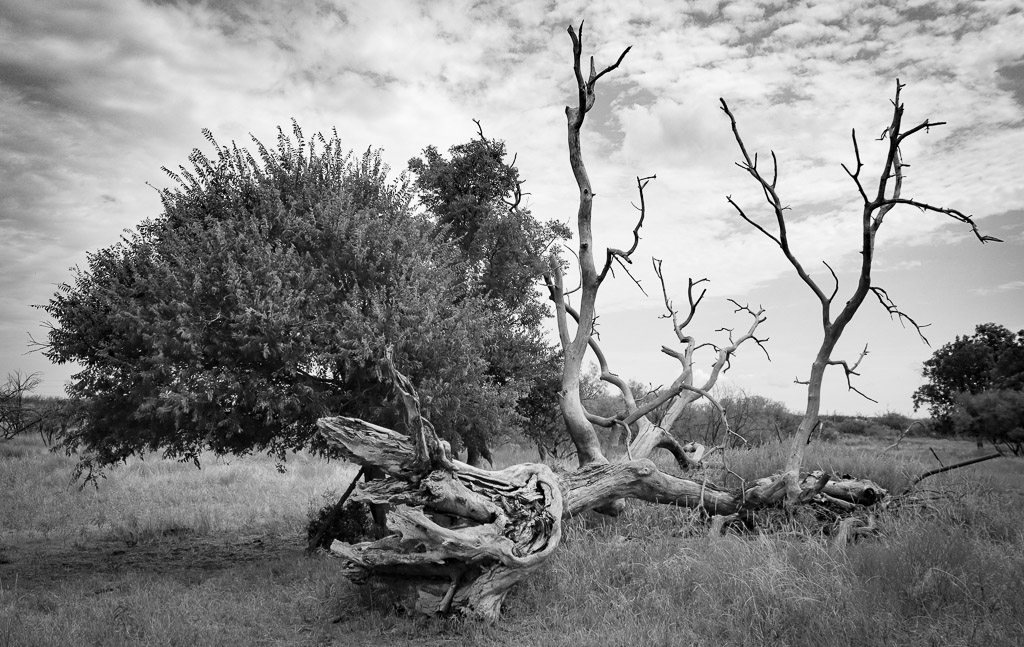
So while avoiding the tall grass, and some red ants that looked almost big enough to saddle, I snapped a few photos of the barn and hopped back in, all without incident. The barn was badly weathered, yes, but the foundation appeared to be intact, and the roof line was still straight as an arrow–‘straighter than my own barn,’ I thought, 50 years its junior. ‘They don’t build them like they used to’ is something old men like me will often say, correctly in this case. (Note to self: Next time you speak with Bub, ask him about that barn, if he has any photos or knows the history of it.)
Crawlspace
Further up the road we came to another house. Until recently, it had been occupied by Mrs. Morris, the owner of the acreage that Bub leases for his Tiger Stripes. She had a birthday coming up the following week, Bub explained, when she would be “only a hundred years old.” Earlier that summer she’d finally moved out to be closer to her children. Before that she’d lived out here on her own, for decades, the nearest neighbor miles away.
The house itself was well maintained, homey, exactly the kind of place you’d expect to find out here–single story, yellow siding with white trim, a wide porch for sitting outside ‘of an evening,’ white lace curtains in the windows, and an antique woven wire fence around the yard. Compared to the dilapidated old barn we’d just visited, you might think that here, you’d be much less likely to run across a whole mess of pit vipers. And you’d be mistaken.
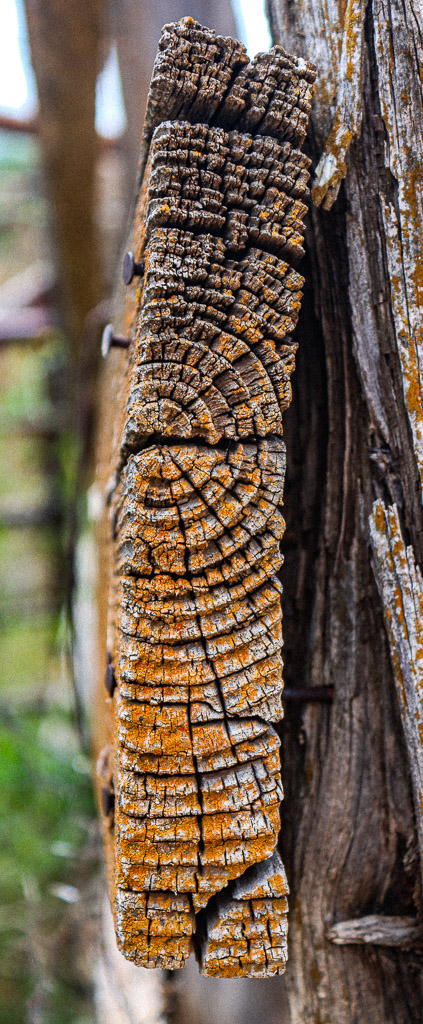
On the day we visited, a crew was there doing some repairs. Those repairs had recently gotten back underway after a temporary hiatus. Apparently, there’d been a problem with the plumbing, which had required going under the house and into the crawlspace, which was found to be teeming with, of course: rattlesnakes.
I don’t know if you’ve ever been in a crawlspace. That word alone–“crawlspace”–is probably more than sufficient to deter most reasonable people from ever venturing down into such a so-named space. Most people have also never come face to face with a rattlesnake. On a ranked list of the very worst places where that could happen, at or near the top of any such list must surely be: a crawlspace.
I didn’t hear first hand the particulars of when that nest of reptiles was first discovered, but I can easily imagine what expletives may have been uttered, which undergarments soiled, and the likely bumps and scrapes sustained by some ranch-style spelunker, in an all-fired hurry to extricate hisself from that demon crawlspace, unpunctured.
So repairs were halted. Deep breaths were taken, drawers changed, calls made, and eventually–miraculously if you ask me–they found a brave crew–“some guys out of Sweetwater” as Bub described them–who were up to the task.
Me? Never in a million years. I’d have sooner sold the property.
Seen by the Unseen
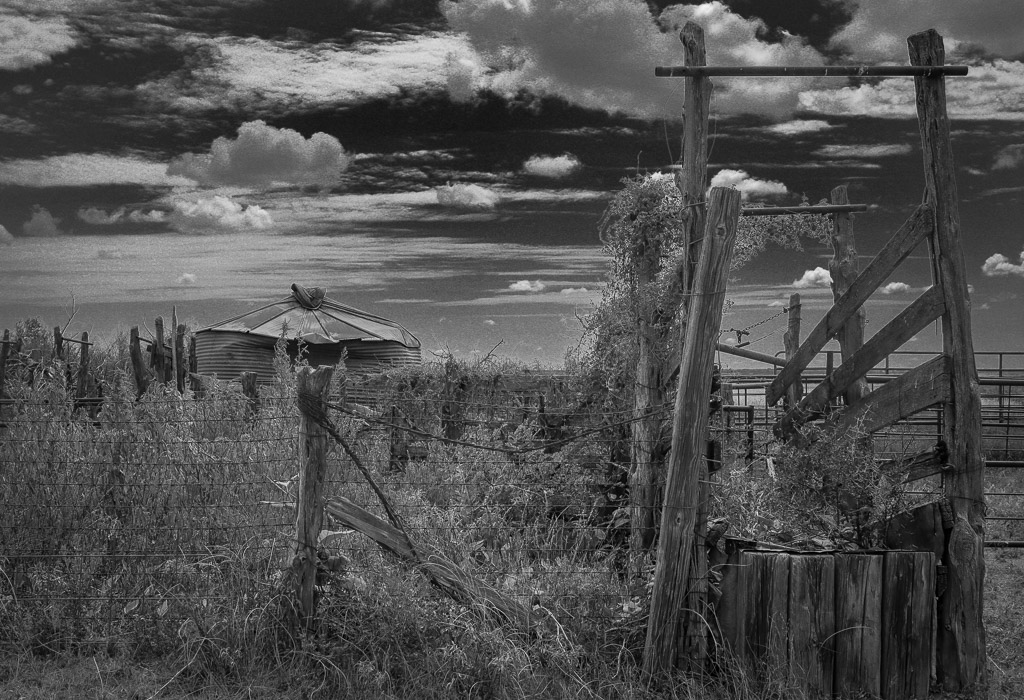
Nearby, we’d stopped for some photos of one of Bub’s old cattle chutes. When I got back in, Bub said “that was an excellent place for a snake, right in there. And they’d have been nice, just sitting there, looking at you.”
For me, that’s the creepiest part of it: you many not see them; but they see you: You are seen by the unseen. And you know they’re there, because this is their home. Snakes, like all wild animals, are always home.
Like Bub said, they’re just sitting there, silent in the tall grass, or flattened out for maximum heat on sun-baked caliche, or cooling off in the shade of an old cattle chute, forked tongues flicking, looking at you.
On the Home Stretch
Mrs. Morris’ place near Afton turned out to be the furthest point in our trip, and from there we headed back toward McAdoo. For the most part, the backroads don’t cut through the 160-acre parcels of land–they trace the edges, so we traveled in a zig-zag pattern of right/left/right/left turns before making it to the highway. After a few of those turns I told Bub that if he’d dropped me off, there’s no way I would’ve ever made it back.
While the property lines are laid out in a grid pattern, the land they cover is anything but uniform. Some areas are flat; others with rolling hills, and still others follow the creek beds, with rocky outcroppings and steep draws.
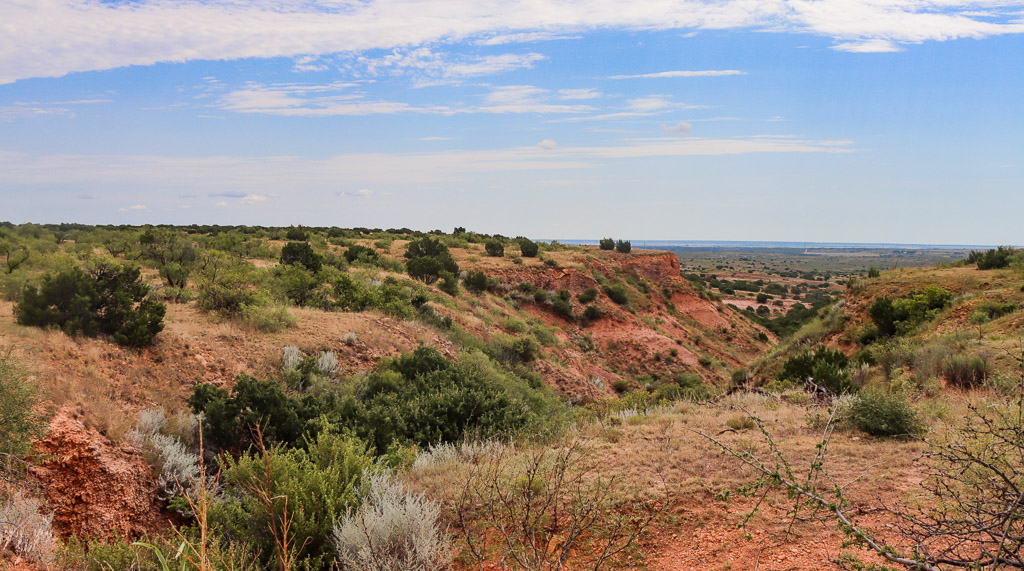
Not surprisingly, the terrain mostly determines the use. The flatter lands are better suited for farming, mostly cotton, while the more hilly terrain is used for cattle and ranching. The uneven ground makes it difficult to maneuver equipment for planting and harvesting, and the low spots trap and hold water. Cotton’s finicky like that: Drought tolerant? Why, sure. Wet feet? No thank you.
Regardless of the topography, land doesn’t come up for sale very often, Bub explained, and when it does, it goes quick. Many of the buyers are from Dallas, and often they can earn more by renting it out to hunters than by farming or ranching.
Power-ful Winds
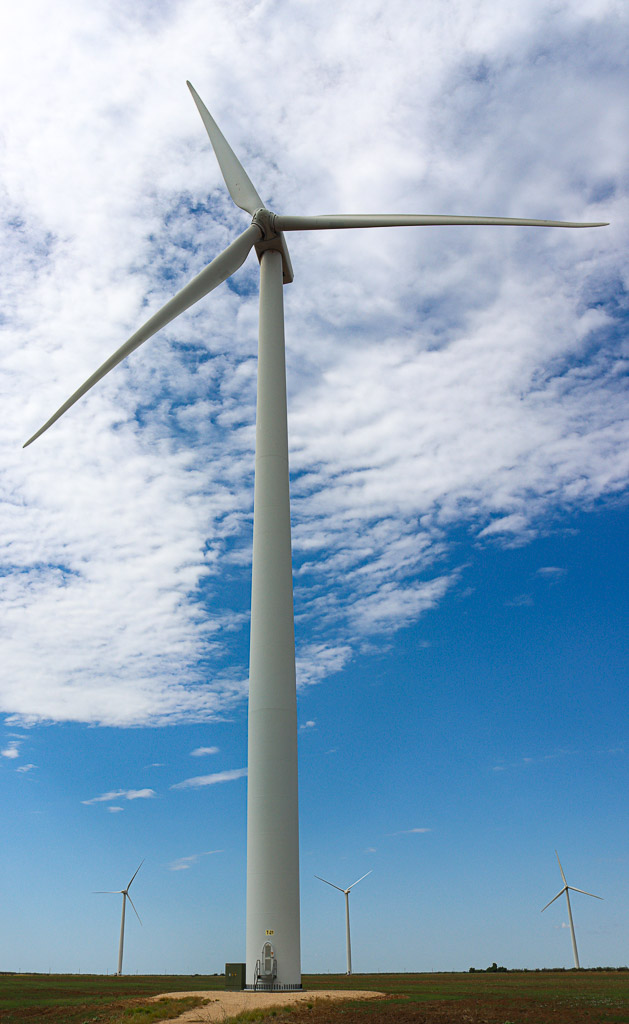
So far, our tour of Dickens county is emerging as quintessentially west Texan. Cattle and cotton? Check. Rattlesnakes and old barns? Check. Red dirt roads? Check. Next is wind. Because if you’re going to tell stories from West Texas, you’re going to have to talk about the wind.
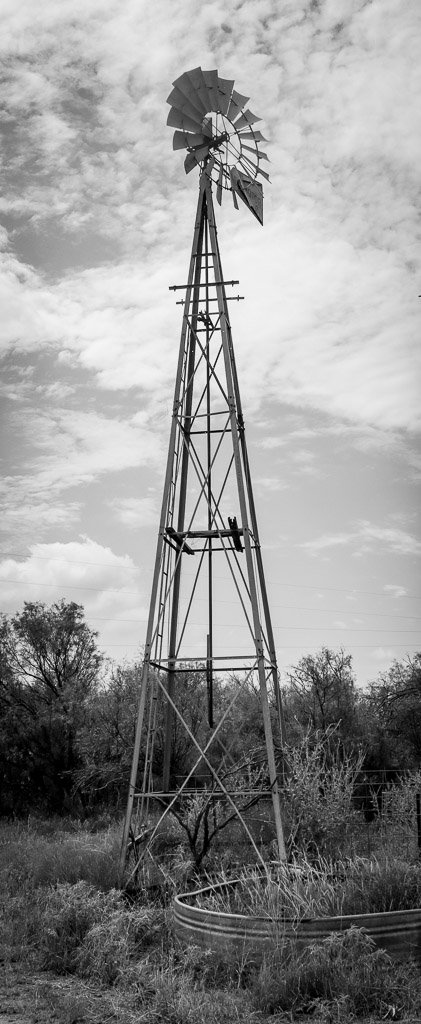
In fact, we’ve already begun this discussion. You may recall from above when Bub talked about the wind whistling through the paper-thin walls of his parent’s farmhouse. These are, of course, the very same winds that now, decades later, spin the massive wind turbines, in some places so ubiquitous as to line the entire horizon.
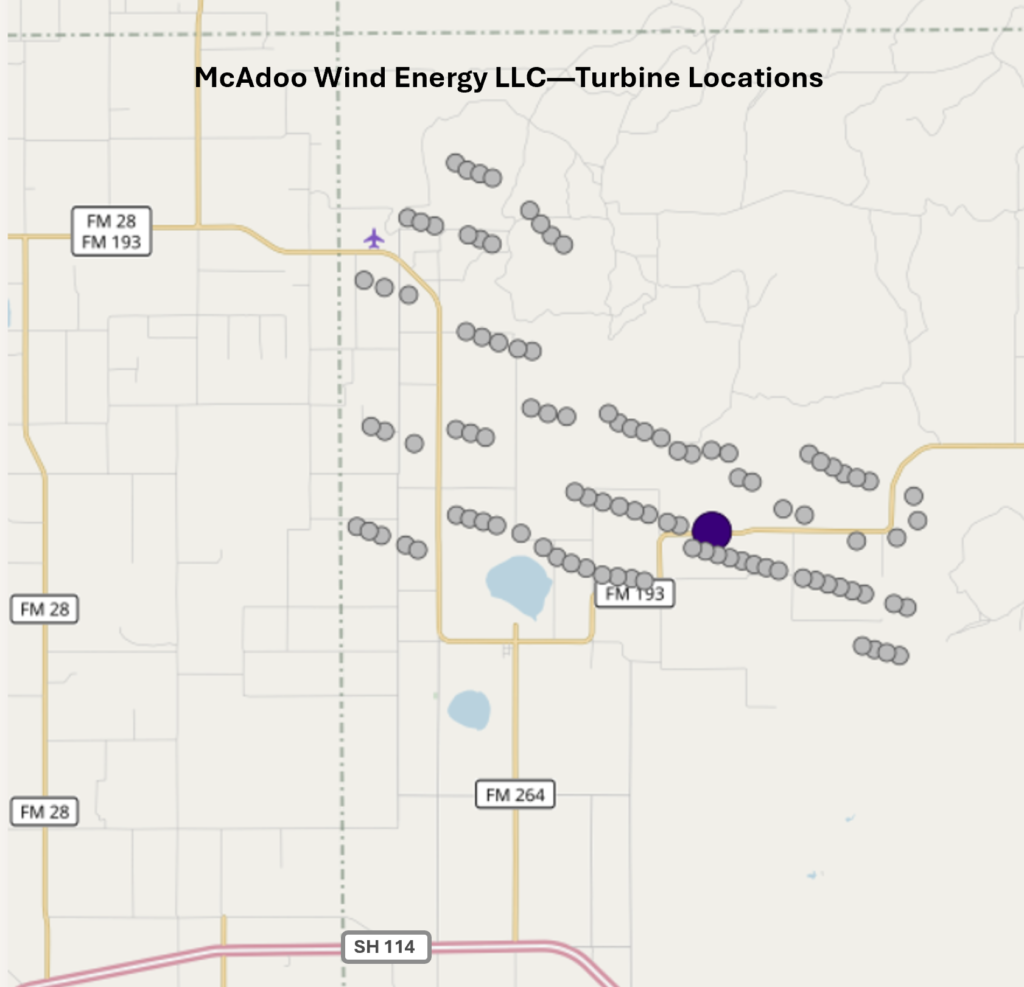
The wind charger of Bub’s father powered a single bulb that hung from the ceiling. Today, the McAdoo wind farm, with about 100 wind turbines in total, produces roughly 360GWh per year, enough to power about 27,000 Texas homes.[8]Invenergy
The Dept. of Energy uses a 1-7 scale to rank geographic areas according to their total wind power (a function of wind speed, over a given area), with higher rank equating to more wind power. McAdoo and Dickens County generally rank 3-4, with areas farther north in the Panhandle ranking higher.
Below is fancy tool you can play around with, zooming in or out, to get real-time or forecasted estimates of wind direction, wind speed, temperature and (wishful thinking) precipitation, adjusted for wherever you click.
The Rural Electrification Administration was created in 1935, by executive order of President Roosevelt. At the time, only 10% of rural homesteads in the US had electricity. Because of the vast distances and low population density, electrification rates in rural Texas were even lower, at just 2.3%. [9]Norris G. Davis, “Rural Electrification,” Handbook of Texas Online, Texas State Historical Association. https://www.tshaonline.org/handbook/entries/rural-electrification
Electricity finally made it to his parents’ farmhouse when Bub was in the 7th grade. “I remember them drilling the holes for the poles. We’d go out and watch.” Work there was completed by the Dickens Electric Cooperative.[10]Dickens Electric Cooperative (DEC) merged with the South Plains Electric Cooperative (SPEC) in in 1999. Click here for a colorful history of DEC and SPEC. Perhaps the lineman below was among the crew that Bub and his friends watched? (Note to self: See if you can identify this gentleman.)
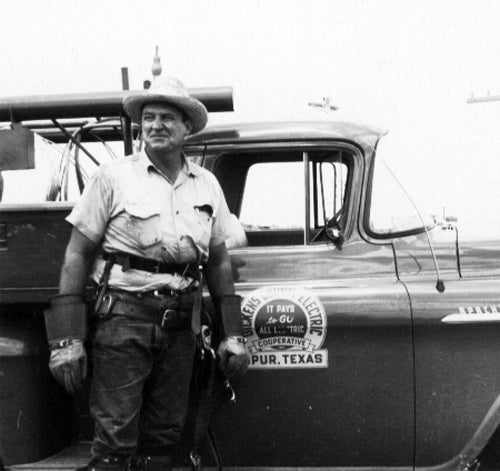
From wind/battery power, to limitless AC power, and now to wind and solar, also limitless–all within Bub’s lifetime. Out here, and for at least the past century, wind and power are intertwined; they connect the past to the present, but also to futures not yet imagined.
From limitless supply to limitless demand
If “futures not yet imagined” seems a bit of a stretch, a bit too dramatic, consider this: a few miles down the road from the turbine in the photo above is Galaxy-Helios–a 160-acre, $1.4B bitcoin mining facility turned AI data center. If built out to the full capacity already approved by ERCOT, it would consume 10-20 times the amount of energy produced by the entire McAdoo wind farm.[11]See: KCBD NewChannel 11 Lubbock; Baxtel
In other words, the situation appears to have shifted—from limitless supply to limitless demand, and it’s unclear where it’s all headed.
“In the morning at 6:30, this road is lined with people to go to work down here,” said Bub. Trucks and forklifts and earthmovers at work clearing land, erecting buildings, the roads within the site wide and newly paved. “Looks better than a state highway” said Bub. “It’s unbelievable the money they’re spending.”
Bub has concerns about the impacts on the water table, and the aquifers below. He knows the number of wells on the acquired properties and wonders if they’ll be sufficient. Once again, and as always, the availability of water is a primary factor in the still-ongoing settlement of the West.
On a hillside nearby, above the construction site, a diamondback gazes down.
Lunch at TC’s Ponderosa
Eventually we emerged from the backroads, and onto Highway 70, which will take you south to Spur, or north to Matador, or, with a right turn at SH 114, past TC’s Ponderosa Bar-b-q, and then westward to McAdoo and Lubbock.
The last time I was on this stretch of highway, we were literally dodging a tornado that seemed hell-bent on chasing us down, driving through the most intense lightning I’ve ever experienced, and with thousands of tiny frogs crossing the road–another story, for another time.
This time through, the weather was perfect, and it was on to TC’s for lunch–the perfect conclusion to our tour of Dickens county.
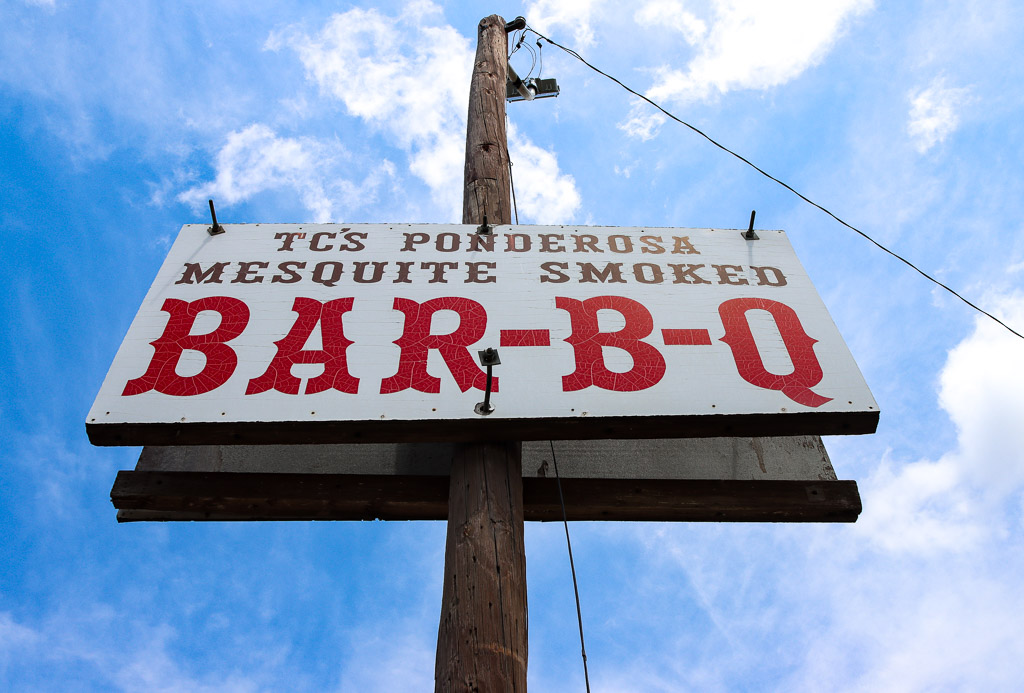
It was packed of course, but with clear distinctions between the customer groups : the locals–farmers and ranchers, tanned, dusty, jeans and boots; construction workers from the AI site–dusty, coveralls and work boots; a few Texas Tech students, headed back for fall semester–the obligatory t-shirt, shorts and flip-flops; and ‘the suits’–the only group (lawyers/realtors/bankers, I guess?) who weren’t dusty, and with shoes that for now at least, still had a shine. Different vocations; all with an appreciation for good BBQ.
Judging from the knowing nods, Bub knew every local in the place. Next to us in line was one of the suits, a younger guy. Bub made him a bit uncomfortable with some precise questions about land prices, and the possible impact of the AI site on water table levels. Poor guy. Polite, though, addressing Bub with “Yes, Sir”/”No, Sir.” He got his order and quickly rejoined his tribe.
As a regular, they knew Bub’s order and had it ready as soon as we reached the head of the line. Brisket, pulled pork, with pickles, onions and jalapenos, and iced tea. As it should be.
Thank you
A warm and sincere ‘thank you’ to Bub and Mary Eldredge for sharing their time and a few of their stories with us—two lives well-lived and they’re both still going strong. These days, most of us tend to be a bit guarded with what we share about our lives, for good reason, I suppose. But there are still some, like Bub, who are willing to open up, and we’re all the better for it. Bub’s openness, along with his resilience, the concern he shows for others, and of course his keen sense of humor–these qualities are inspirational for me.
Also a thanks to you, Fellow Travelers, who rode and read along with us. And a gentle nudge for you to do the same. Everything here–the stories, the tour, the kolaches in the driveway–all of that took less than half a day. The write-up took longer, but the living of it did not. Surely there are a ‘Bub and Mary’ in your life too. Call them. Go see them if you can. Hear their stories, and share one of your own.
Safe travels, Y’all.
References
| ↑1 | For more information on McAdoo schools and Dickens county, please refer to the Dickens County Historical Commission. |
|---|---|
| ↑2 | For more information, contact the McAdoo School Historical Society, at P.O. Box 86, McAdoo, TX, 79243 |
| ↑3 | High schools that have matched or exceeded McAdoo’s 3-in-5 performance include: Bowie/Tucker, Buna, Kimball, Kountze, Krum, Morton, Nazareth, Port Arthur Lincoln, and Snook. Sources: UIL State Boys Basketball Champions; UIL State Basketball Records. |
| ↑4 | For a deeper dive into the glorious tradition of Texas sports writing, the logical starting point is Blackie Sherrod—16-time Texas Sportswriter of the Year and, by wide consensus, the dean of the craft, anthologized in The Blackie Sherrod Collection (1988) and Blackie Sherrod at Large (2002). Sherrod mentored a remarkable generation including Dan Jenkins, Bud Shrake, and Gary Cartwright—collectively known as “Blackie’s Boys.” Jenkins’s I’ll Tell You One Thing: The Untold Truth About Texas, America & College Football (1999) offers a characteristically irreverent look at the tradition, while Cartwright’s Confessions of a Washed-Up Sportswriter (1982) remains the most reflexive account of the craft itself—its excesses, its pleasures, and its vanishing world. |
| ↑5 | KCBD story from 2005 |
| ↑6 | The Federal Aid Highway Act of 1956, Eisenhower’s sweeping legislation that created the Interstate Highway System, triggered a cascade of road-widening and right-of-way acquisition across the country, including rural Texas. For current TxDOT policies, see : TxDOT Right of Way Acquisition Manual, Chapter 5, Section 8 and also the ROW Appraisal Manuall |
| ↑7 | The Little Dribblers Bub refers to is a youth basketball program, focused on player development, and founded in nearby Levelland, in 1969. |
| ↑8 | Invenergy |
| ↑9 | Norris G. Davis, “Rural Electrification,” Handbook of Texas Online, Texas State Historical Association. https://www.tshaonline.org/handbook/entries/rural-electrification |
| ↑10 | Dickens Electric Cooperative (DEC) merged with the South Plains Electric Cooperative (SPEC) in in 1999. Click here for a colorful history of DEC and SPEC. |
| ↑11 | See: KCBD NewChannel 11 Lubbock; Baxtel |