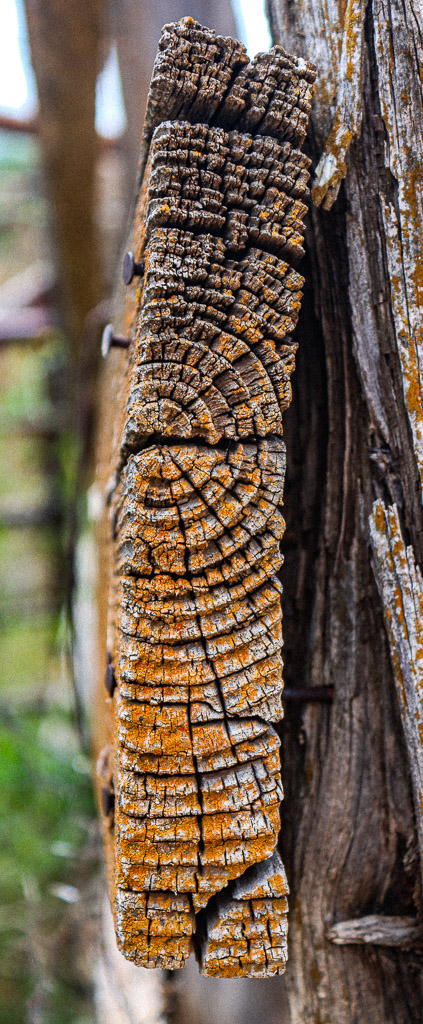
This is a close-up photo of an old cattle chute, near Afton, Tx. The orange/rust-colored growth on the wood is lichen. More specifically: crustose lichen. An unassuming creature, it’s not clamoring for your attention. But if you offer it, it will return the favor, and teach you plenty.
First about the name: ‘Crust-ose’ is a two-syllable word. The first one rhymes with ‘bust,’ and the second with ‘dose,’ and both derive from latin. Crusta means crust, rind or shell–giving us the English words crust and encrust, or, by way of French: crouton.
And the suffix -ose means “full of” or “having the quality of” and you see it everywhere: verbose (full of words, like me, I must admit), grandiose (full of grandeur, like a Charolais bull), or comatose (full of chicken fried steak, like many Texans after a proper meal).[1]One more, a personal favorite: “jocose,” from the Latin jocus–to joke or jest–the same root that gives us “joke” or “jocular.” Someone who is jocose is … Continue readingSo basically, after all that: crusty lichen.
Lichen is not a plant. It’s a composite organism composed of a fungus and an alga, working together.[2]Texas Parks & Wildlife Department. “Lichens,” by Ilo Hiller, 1983. https://tpwd.texas.gov/publications/nonpwdpubs/young_naturalist/plants/lichens/The fungus provides structure and captures moisture; the alga does the photosynthesis, manufacturing food for both. More recent research[3]Spribille, T., et al. (2016). Basidiomycete yeasts in the cortex of ascomycete macrolichens. suggests that lichen may in fact be a 3-part organism, with a specific yeast playing a vital role. But the symbiosis remains–none of the three could survive out here alone. Pretty cool.
We often understimate the impact and importance of lichen, which cover an estimated 6-8% of the earth’s land area–significantly more than the rain forests.[4]Asplund, J., & Wardle, D. A. (2017). How lichens impact on terrestrial community and ecosystem properties. Biological Reviews, 92(3), 1720–1738. Lichen are a primary force in breaking down inorganic rock so that vegetation can eventually take hold. Surprisingly they are not major decomposers of wood, which they use as a substrate for their growth, like a crust on the surface, as described above. They are also provide some level of suncreen protection for the wood, slowing its UV decay.
Next is air quality. Now, Fellow Travelers, when you think of places where the air is ‘crystal clear,’ as my Grandfather was fond of saying, West Texas will probably not be atop your list. Understandable. It’s windy after all, windy and dusty. Out here, a ‘gentle breeze’ is not something you experience, but only hear about, from friends and family who live elsewhere. Out here, the wind has its own agenda, and for every season there’s a different type of wind, most of them calamitous: tornadoes and dry lines in the spring, dust devils and haboobs in the summer, and blue northers in the fall and winter.
So, wind = dust = lowered air quality. That’s all true. But it’s also true that dust is particulate matter, which is usually not as bad or as toxic as industrial or chemical pollution. And, guess what: an indicator that the air quality ain’t too bad–other than for particulate matter–is the presence of: lichen, just like the lichen I found out near Afton.[5]Texas A&M Forest Service. “Lichen.” Texas Tree Health series. https://tfsweb.tamu.edu/trees/tree-health/whats-on-my-tree/lichen/
So for those of you from elsewhere, be grateful for those gentle breezes, for Sinatra’s summer winds. And for you Texans that live in this part of the state, well, what can I say? Take a deep breath, Y’all. Do it through a mask, if and when conditions merit, or though your sleeve till you can get inside, but in any case, relax. We’ve all got things to worry about, but for almost all y’all, the quality of the air out here ain’t your biggest concern. Ask the lichen. It knows.
Speaking of relaxing, here’s a final lesson from the lichen. Next time you find yourself rushing for an appointment, not callin’ your parents like you shoulda, or drivin’ faster than you oughta, take a cue from Mr. Crustose Lichen here, who will be perfectly content to have travelled and grown this year for a total of: one millimeter.
That’s right, the typical growth rate of lichen is but one millimeter per year. [6]Munteanu, Nina. “Life on a Fence Post — A Lichen Study.” The Meaning of Water. January 12, 2025. https://themeaningofwater.com/2025/01/12/life-on-a-fencepost-a-lichen-study/ — citing … Continue reading The recently fashionable ‘slow food,’ ‘slow travel’–generally, I’m a fan, but Brother, they got nothin’ on Mr. Lichen. He’s the OG, of low and slow.
Before you go, take one last look at the photo. Is it possible to draw inspiration from a patch of lowly lichen? I think so. If you’ll allow it, you can be inspired by the resilience required to grow this large, at a pace of just one millimeter per year. If you’re attuned to it, this patch of lichen will remind you to occasionally slow down, and see the beauty all around.
Before you head back to the hustle and bustle, go call your Parents, on the phone or with a prayer, and please tell them I said hello. If you’re headed back to McAdoo, here’s a short cut:

References
| ↑1 | One more, a personal favorite: “jocose,” from the Latin jocus–to joke or jest–the same root that gives us “joke” or “jocular.” Someone who is jocose is given to joking. Not slapstick, never cruel, but playful speech, like when Bub Eldredge in McAdoo explains why he was able to buy his first house for cheap: ‘because it was in the middle of the road.’ Or when Luis Guzman, over at Crosby County Fuel doesn’t just tell you the joke, but does watch closely for your reaction after you read the joke, that’s printed on the t-shirt he’s wearing: “my stomach is flat, but the “l” is silent.” Bub and Luis (and pretty much any of the regular you’ll run into over at the co-op) are jocose. It is, in my view, among the highest of compliments. |
|---|---|
| ↑2 | Texas Parks & Wildlife Department. “Lichens,” by Ilo Hiller, 1983. https://tpwd.texas.gov/publications/nonpwdpubs/young_naturalist/plants/lichens/ |
| ↑3 | Spribille, T., et al. (2016). Basidiomycete yeasts in the cortex of ascomycete macrolichens. |
| ↑4 | Asplund, J., & Wardle, D. A. (2017). How lichens impact on terrestrial community and ecosystem properties. Biological Reviews, 92(3), 1720–1738. |
| ↑5 | Texas A&M Forest Service. “Lichen.” Texas Tree Health series. https://tfsweb.tamu.edu/trees/tree-health/whats-on-my-tree/lichen/ |
| ↑6 | Munteanu, Nina. “Life on a Fence Post — A Lichen Study.” The Meaning of Water. January 12, 2025. https://themeaningofwater.com/2025/01/12/life-on-a-fencepost-a-lichen-study/ — citing the 1mm/year growth rate, which is widely accepted in lichenology literature. |