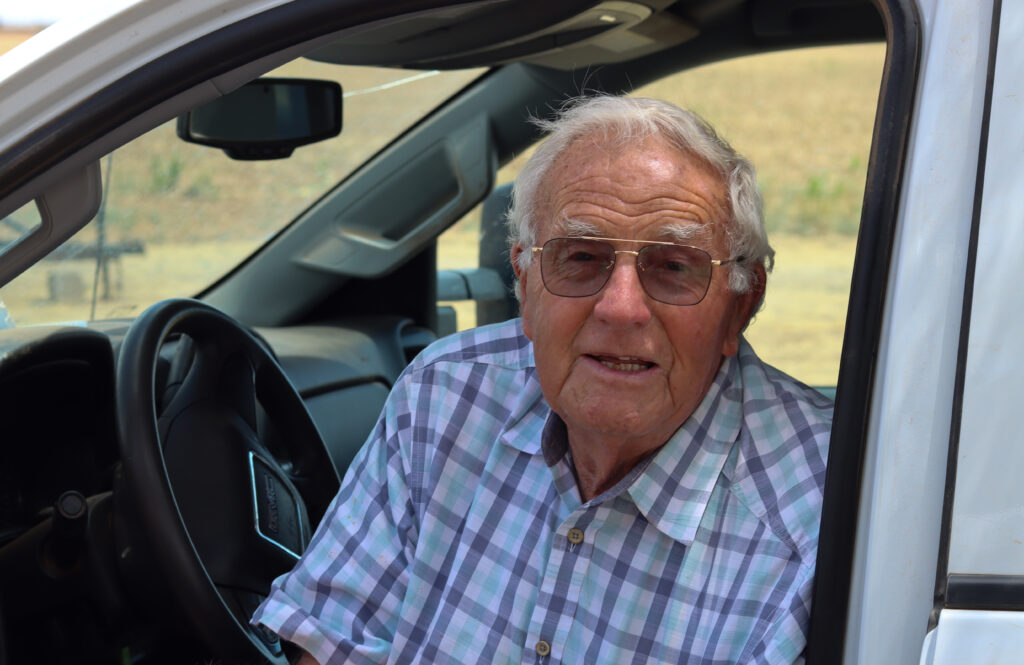
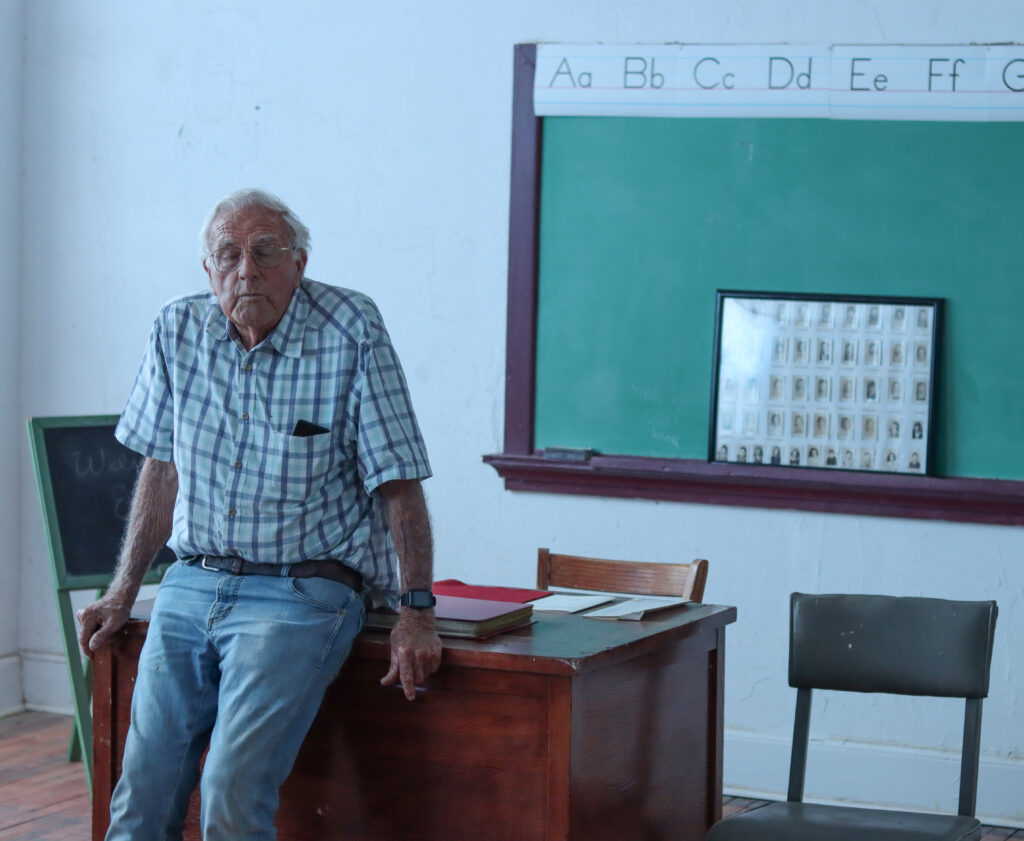
This is Bub Eldredge. He raises crops and cattle near McAdoo, Texas, taking care of a thousand acres, mostly on his own. He’s 83 years old. So, what did you get done today, city slicker?
But that’s my question, not his; because he’s not the kind to talk that way. I met Mr. Eldredge earlier this week (August ’22). I was introduced to him by the Guzman brothers. He showed me some of his antique farm implements, including this horse-drawn planter.
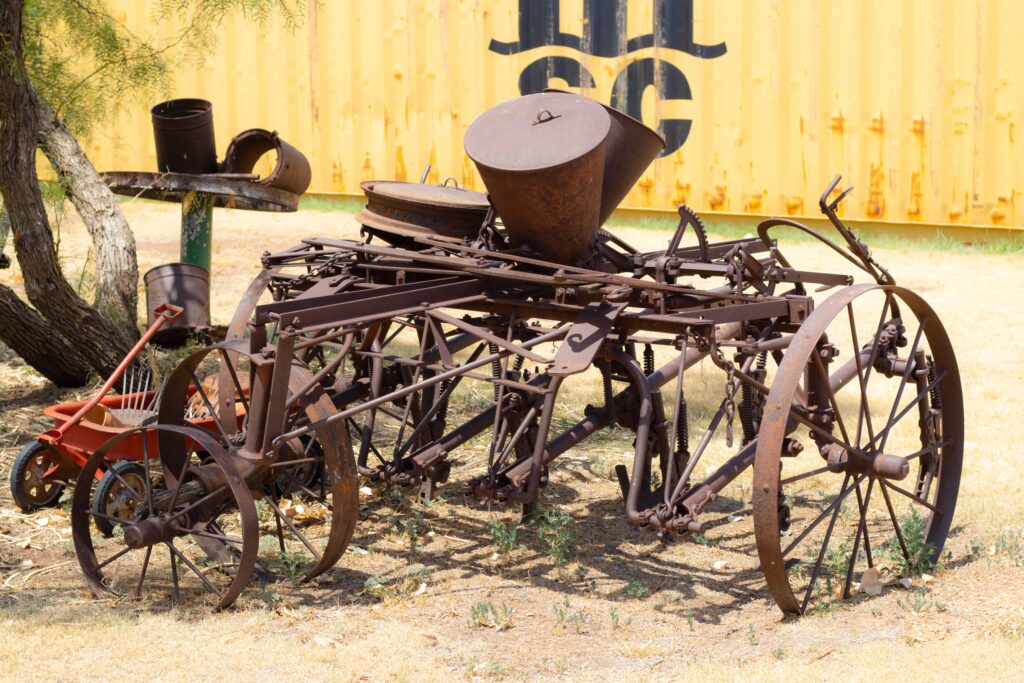
The horse or mule that’s pulling it, he explained, would sway from side to side as it walked. So the men operating it, were constantly having to steer as well, in order to plant straight rows. We marveled at the amount of work these men were able to accomplish in those days, using only the power of horses and mules.
From the perspective of most of the rest of us, who work behind a desk, what he is accomplishing every day, at 83, is rather impressive as well. I told him so. He didn’t say anything, but smiled in acknowledgement.
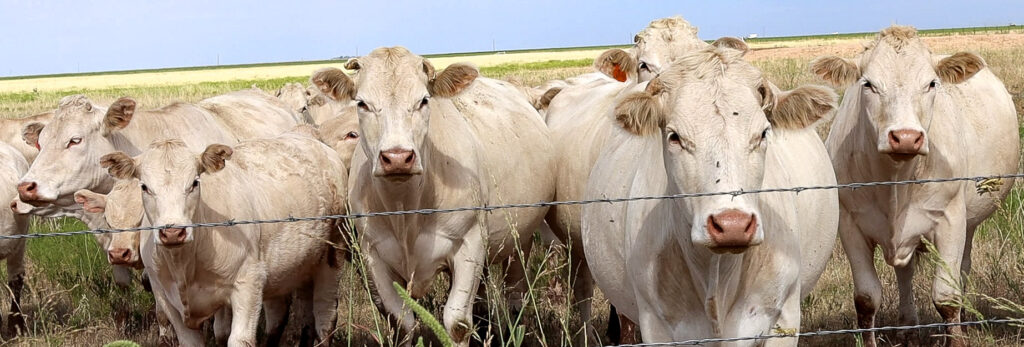
As you might imagine, there’s a whole lot more to tell about Mr. Eldredge–as rancher, farmer, school principal, basketball coach, and also as former teacher of the aforementioned Guzman brothers, back when they were in school.
Decades later, the good-natured jabs continue. Bub: “Like I always told Luis, if you’d have quit chasing the girls around, you could’ve made something of yourself.” Luis: “And if you’d have been a better teacher, I could’ve been a doctor!” And so were re-told, for my benefit this time, these well-rehearsed lines of attack and counter-attack.
“You wanna hear some o’ that junk?”
I finally got a chance to get back out visit with Bub. I’m embarrassed at how long it took me to get that done. Graciously, Bub didn’t miss a beat, and offered to show me around. I drove in the night before from Dallas. I brought kolaches for breakfast, and we sat in his pickup before heading out. He asked where we might pick up our conversation. Maybe your early days in McAdoo? I suggested.
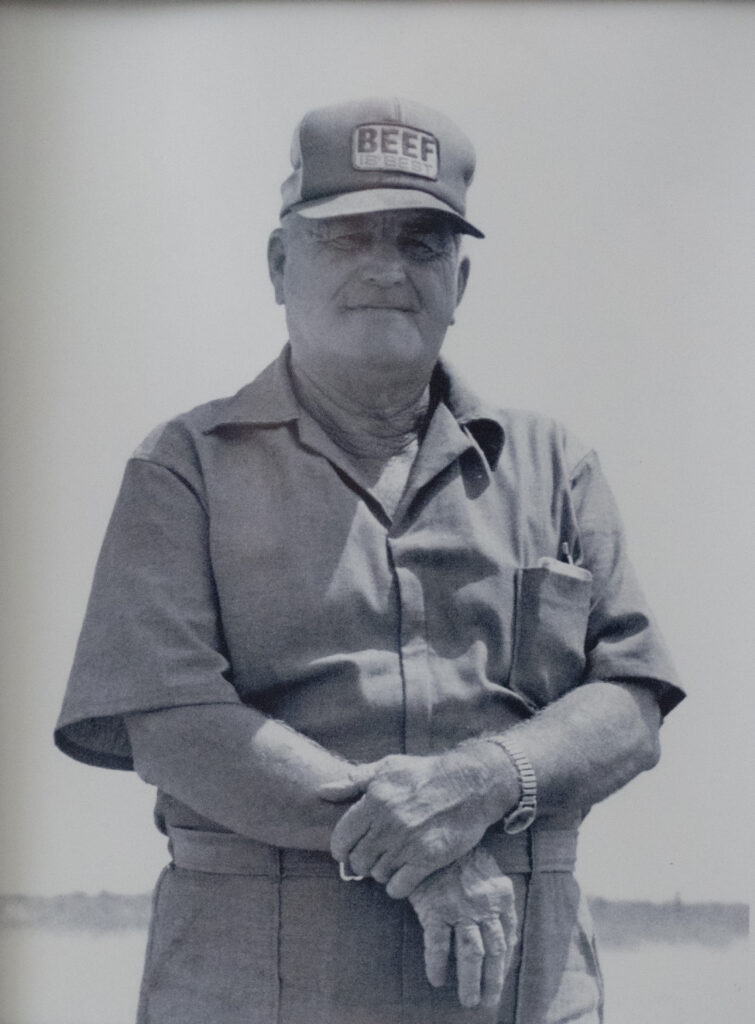
You wanna hear some o’ that junk? My dad, they owned the filling station right down the road from here. And probably, I was born in ’38. And so when I was six years, I guess six years old, he moved, he bought the farm behind the station. And they moved up to that farm, an old house that had been there 100 years. And they put paper on the wall and you could see the paper wind blowing. It was cold…that was a hard time…
And no electricity. He had a wind charger at the filling station. He moved up there and had about 10 batteries in the back porch. And that’s, they had one little light hanging down in the school, I mean in the house. No, no restrooms, outside toilet.
No sugar, you know, of course my Dad had the filling station, he got sugar there. That was the only filling station from here to there. You know, people knockin’ on the door and wantin’ to get gas, and you never knew who they’s going to be or who they wasn’t going to be. [See, it’s the same thing now. Now I’m bothering you in the same way that those people used to bother your Dad. You never know who’s going to show up on your door.] Yeah, but anyway, they moved in that house up there, just they hadn’t, barely had a dime to live on, you know.
Rich in other ways
They didn’t have much money, but in other ways, they had plenty.
They had the cattle. They fed cattle out, that’s how he bought that farm. They milked cows. And they set those cream cans out on the dirt road, and they come by and pick ’em up. [Raw milk.] No, I think we had that separator. We had to…and we separated, and we sold the cream. [Did you make the butter and stuff too at home?] Yeah, we put it in a [a churn] a jar. We shook it. We didn’t have no, oh we had to shake it to make it. [You were the churn] Yeah.
Of course, my folks, you know, then everybody had a…they built a house for little chicks. They’d order about 200 of those. And they come in the mail. [200. Yeah.] And then they had that. And then they had another for hen [hen house.] For the hens, yeah. [But when you got 200, you got boys and girls both.] Well then I don’t think they, you just got what you got. [You got what you got. A straight run.] A straight run. [Yeah.] Because I don’t think they had any way to…to separate ’em. [Yeah. I got four now.] You got four? [Four hens.] Oh, really? They give you enough? [Yeah, that’s enough. Yeah. Three eggs a day, pretty much. Yeah. That’s enough. Anyway, so yeah. You get ’em, get the chicks in the mail….]
Yeah, that’s the way you order ’em, the post office, you know, they deliver ’em to you. Well, we, what we did, when they got bigger, then they’re called fryers. But, we had some kin folks, they’d come and we’d catch, ring their…ring their necks. Yeah. And then they’d dress them.
Baseballs and cotton bolls
In those days, and still for the most part today, property was divided into 160-acre parcels, or “quarter sections,” in the language of the old survey system, where a full “section” was one square mile, or 640 acres. With the sides of each quarter section measuring a half-mile, neighbors were on average about that same distance apart.
The place that we bought, the Gollihars farmed it with mules. He had a house on every 160 acres and those hands farmed that land. I don’t know how they did it. Then, we didn’t have cars. So our place up here, and the neighbors are half a mile, and another half neighbor half, and another half. We’d all meet in the pasture and play baseball. [Nice. I bet grounders were a bummer.] Yeah. So that’s the way we did that back there when we were kids, you know. That’s the way we played.
The Van de Leer place over there, he brought cotton to the gin up with his mules. They turned school out two weeks for cotton pullin’. And I wasn’t very good, so they made me do the weighin’. And they bring it up there, and you had to, you weighed it. And up here we had a garage. We had about 10 people stay in it, and then another shack, they had about 10 there, and about 20 out at the barn he fixed. And then we had those…you know, weigh ’em. And they didn’t want any green bolls. Some of ’em wanted to put green bolls; they weigh more. So you had to watch all that.
School days
Bub started school in the fall of 1945, just as WWII was coming to an end. “They put me on the bus. And I didn’t want to go, ’cause I’d have rather stayed here with the cows” he told me. “I went to school 12 years at McAdoo, up through the 12th grade.”
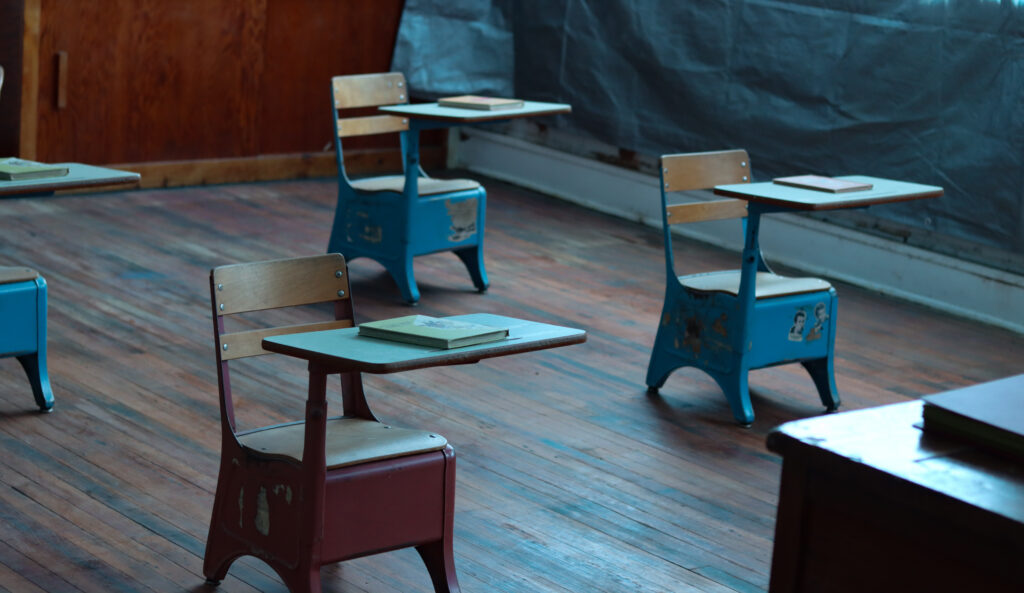
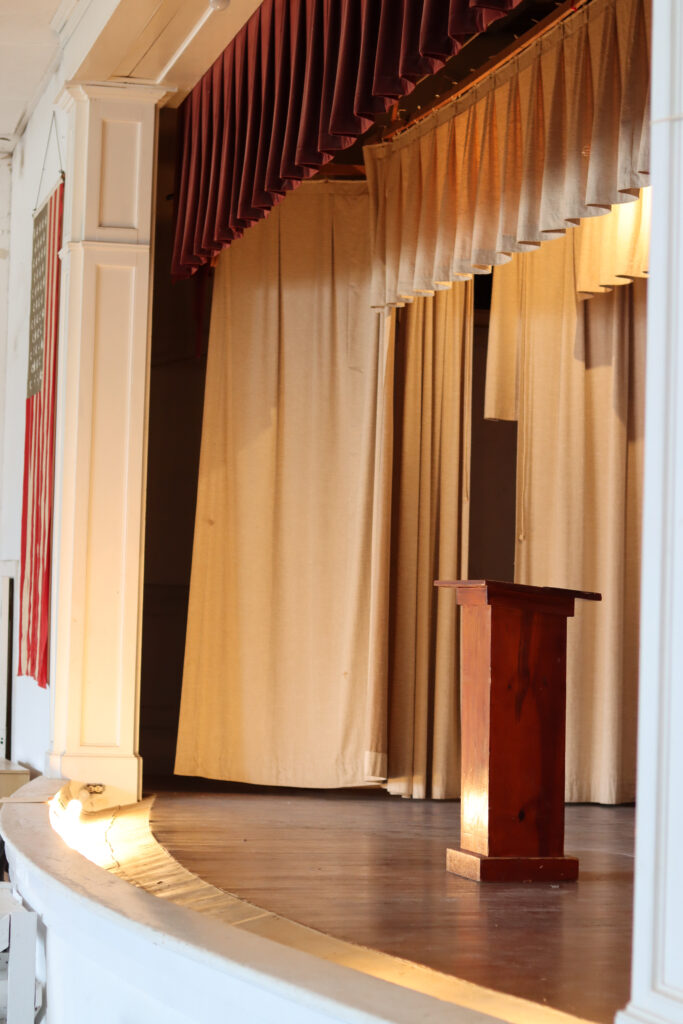
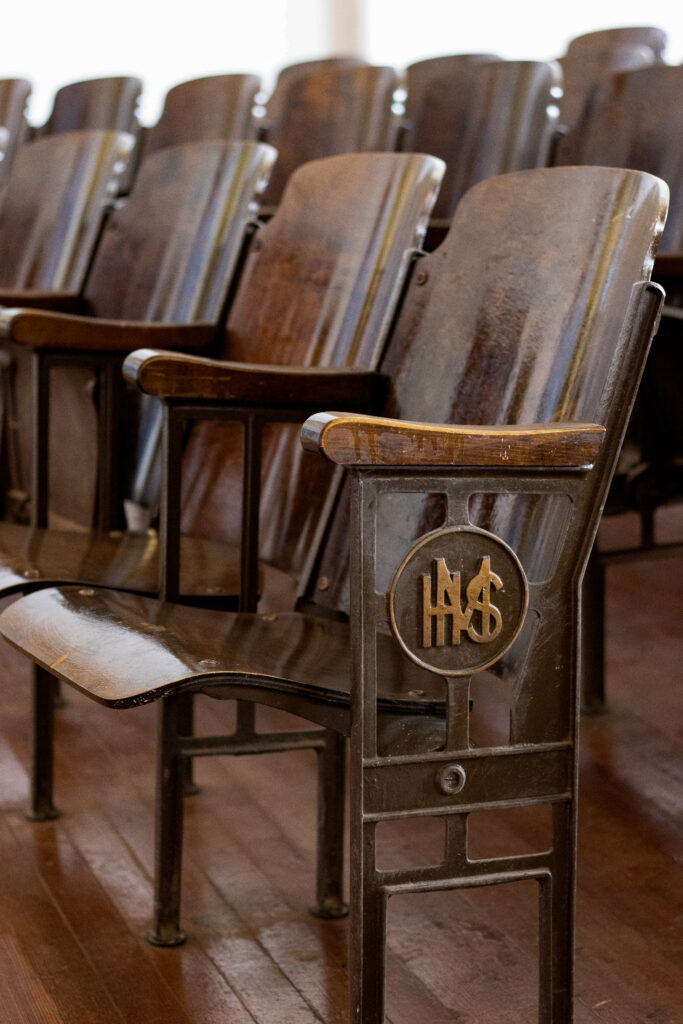
The first school in McAdoo was established in 1908, predating even the official formation of the town in 1915.[1]For more information on McAdoo schools and Dickens county, please refer to the Dickens County Historical Commission. The McAdoo school where Bub attended, and his father Raymond Eldredge before him (Class of 1932) was built in 1928, and continued until its closure in 1985, one of several school district consolidations in Texas during the mid-1980s. The main school building itself, however, thanks to local volunteers and donors, is immaculately preserved.[2]For more information, contact the McAdoo School Historical Society, at P.O. Box 86, McAdoo, TX, 79243 Bub gave me the full tour.
The desks, the books, the auditorium, all just as they were–silent now but somehow expectant, as if the bell might ring any moment, students bursting in. Bub told a few stories of his school days, standing in the very same classroom where they’d unfolded decades ago. Were these remembrances he was sharing? Or echoes from the past?
Basketball
When you drive into McAdoo, there’s a welcome sign, standing prominently on the northeast corner of FM 193 and FM 264.
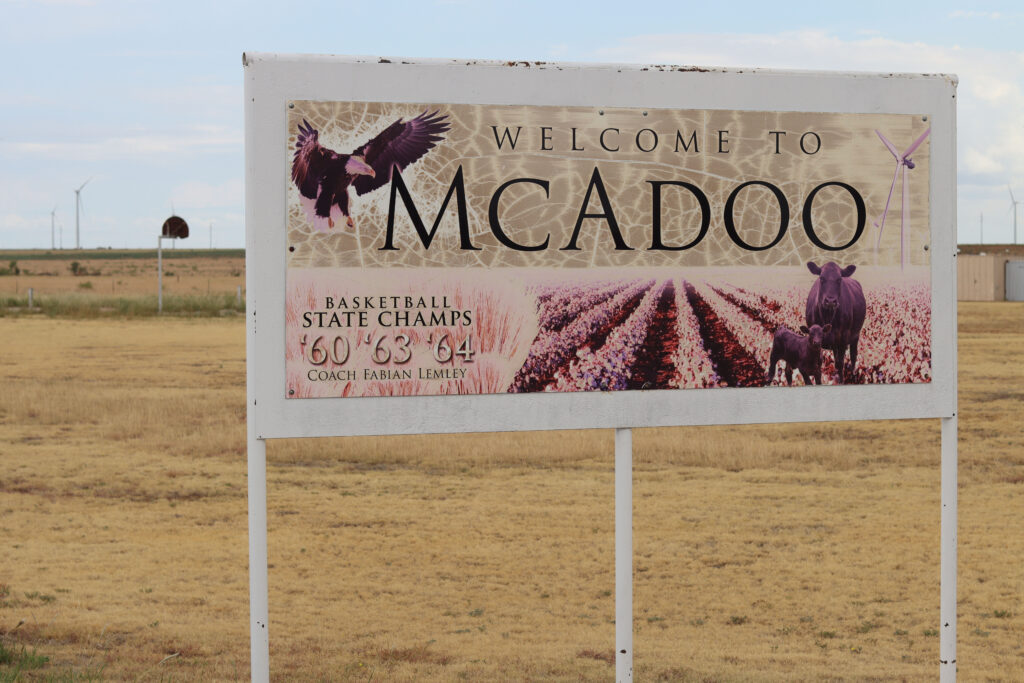
This sign informs all comers that three state basketball championships were won here, all within a 5-year span, under Coach Fabian Lemley. That’s pretty impressive. If fact, in the 100+ year history of UIL Texas high school basketball, less than ten programs have matched or exceeded McAdoo’s 3-in-5 performance. [3]High schools that have matched or exceeded McAdoo’s 3-in-5 performance include: Bowie/Tucker, Buna, Kimball, Kountze, Krum, Morton, Nazareth, Port Arthur Lincoln, and Snook. Sources: UIL State … Continue reading.
When I saw that sign on my first trip to McAdoo back in ’22, I remember wondering if there was anyone still around who could tell me about about it. As serendipity would have it, I learned during my most-recent trip that one of the key players in that past success–as a player, literally, and later as coach–was none other than: Mr. Bub Eldredge.
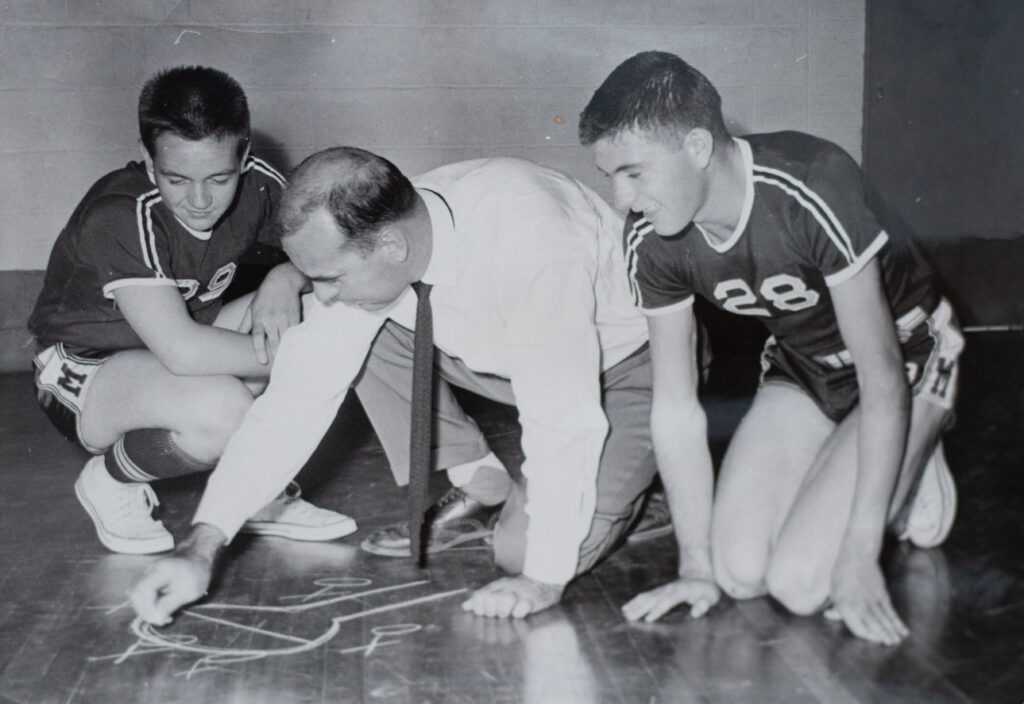
Started basketball, you know, in McAdoo, we started in the fifth and sixth grade. We played on Monday and Thursday. You wonder how we finally got good, you know? That’s all we had to do.
So then when I was in eighth grade up here, one of the basketball coaches—that’s why I was so smart—he took me to the gym, in my off period and we played basketball. Supposed to have been studyin’ you know.
Then you could play with the JV team. That was legal then. You couldn’t play with varsity, but I played with the JV.
“Bub Eldredge went wild…”
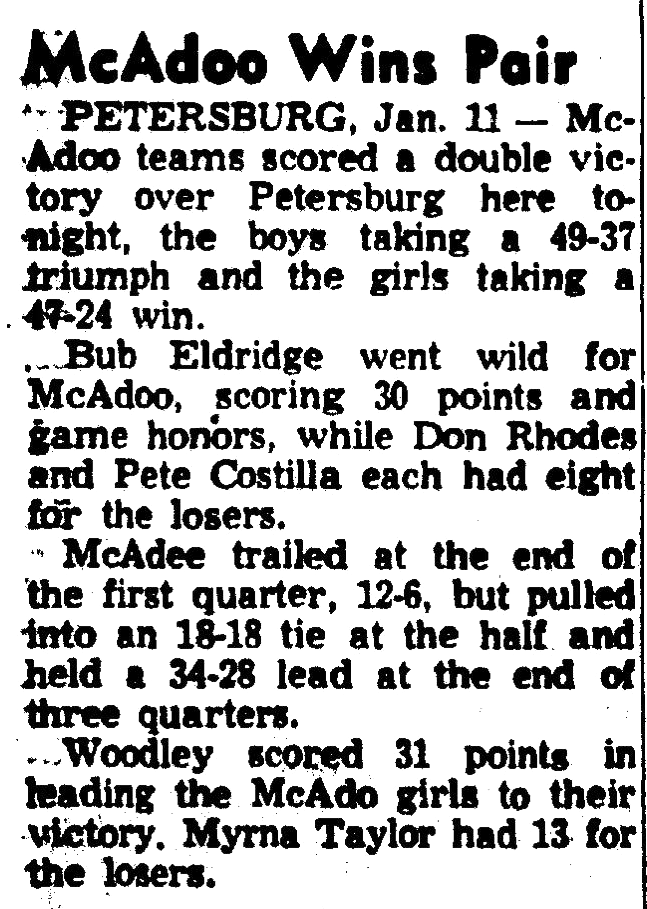
From playing with the high school JV team as an 8th grader, Bub went on to become one of the leading scorers for McAdoo and all of Districts 9 & 10. In small West Texas towns of the era, and for some even today, high school sports were at the center of community life. And the local papers covered them with a certain, shall we say, exuberance. In honor then, of the great sportswriters of 1950s Texas,[4]For a deeper dive into the glorious tradition of Texas sports writing, the logical starting point is Blackie Sherrod—16-time Texas Sportswriter of the Year and, by wide consensus, the dean of the … Continue reading I give you:
In Bub’s senior campaign of 1956-57, the high-flying McAdoo Eagles notched 24 victories against a mere five reverses, storming the hardwood to claim first-place tournament silverware at Girard, Patton Springs, and the Floydada Invitational, where the sharpshooting Eldredge copped All-Tournament laurels. In a January ’57 tilt against Petersburg, “Bub Eldredge went wild for McAdoo, scoring 30 points and game honors” in a scintillating showcase of roundball wizardry. In the girls’ contest, McAdoo’s Woodley flipped in an equally-impressive 31 in their victory. Members of that year’s crack men’s squad included Maybron (Bub) Eldredge, Neal Allen, Curry Brantley, Benny Brown, Tom Coffey, Neal Crosby, Van Cypert, Earl Hardy (manager), V.B. Scott, Kenneth Wallace, Richard Ward, Foy Westfall, and Dick Woolley–an iron-willed brotherhood of hard-nosed hoopsters, guided by the rock-steady hand of Coach Fabian Lemley.
College Ball and a Conference Championship
My math teacher carried me to Clarendon Junior College to try out for basketball. So he carried three of us down there and they gave me a full scholarship. And they give those two boys a half scholarship. But that was in ’57, ’58 I guess, we went on over there. We won that conference, believe it or not.
[Coach] Buddy Travis. He was good. I guess we was graduated, went by and talked to him. He said, that’s why we all turned out coaches. He changed the plays nearly every week. Everything, every school we played. You know, we played Howard County, then Lubbock Christian was junior college, Frank Phillips, and, Odessa, I guess then. [And he changed the plays up every week?] Yeah. Every time. That’s why we all went to be coaches.
He told us you could make the basketball team. But said, you didn’t know about your subjects, you know, if you could pass or not. But anyway, you know, you take a few basket weaving classes, just in case. [Yeah. Help your GPA a little.] But didn’t need them.
Then from there, went to West Texas, started playing ball up there. Got hurt up there. And knocked me outta that. [What happened?] My, my back. I had to have it operated on. Then they took a disc out. Then you didn’t fuse it or nothing, you know? So I got out there and come back to McAdoo.
Coach Eldredge
After West Texas A&M, Bub returned to McAdoo in 1961 and began coaching in 1962, as Assistant to Coach Fabian “Doc” Lemley. These were the glory days of McAdoo basketball, yet to fully dim, as the glinting trophies still attest.
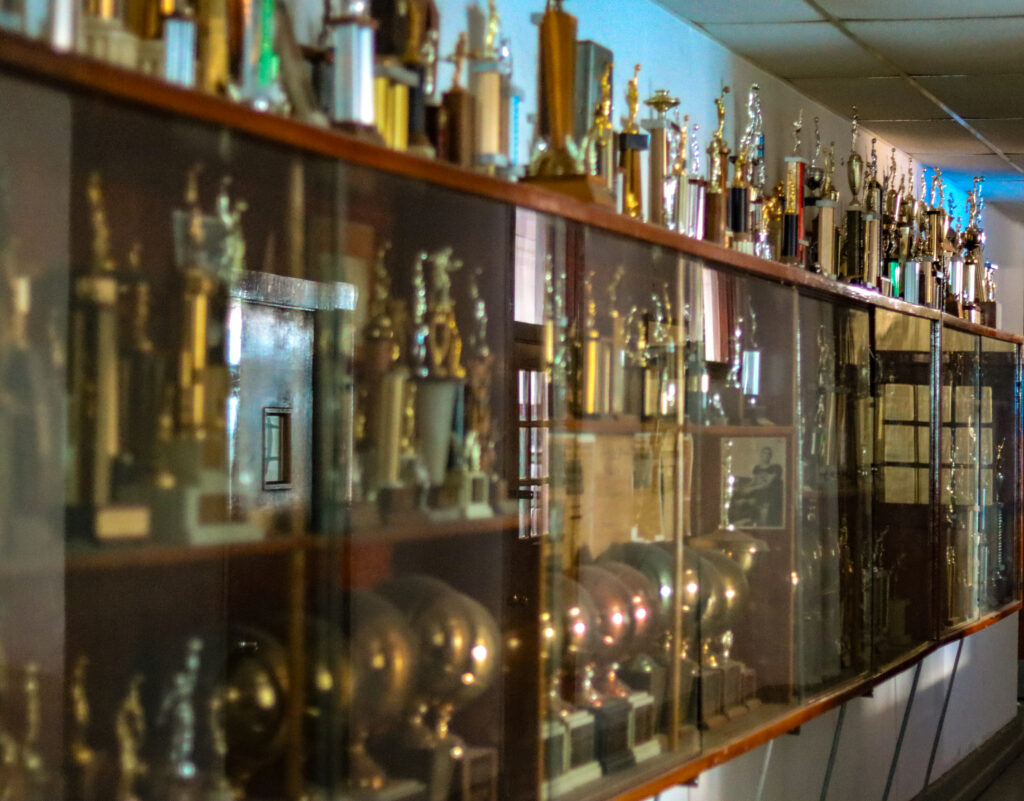
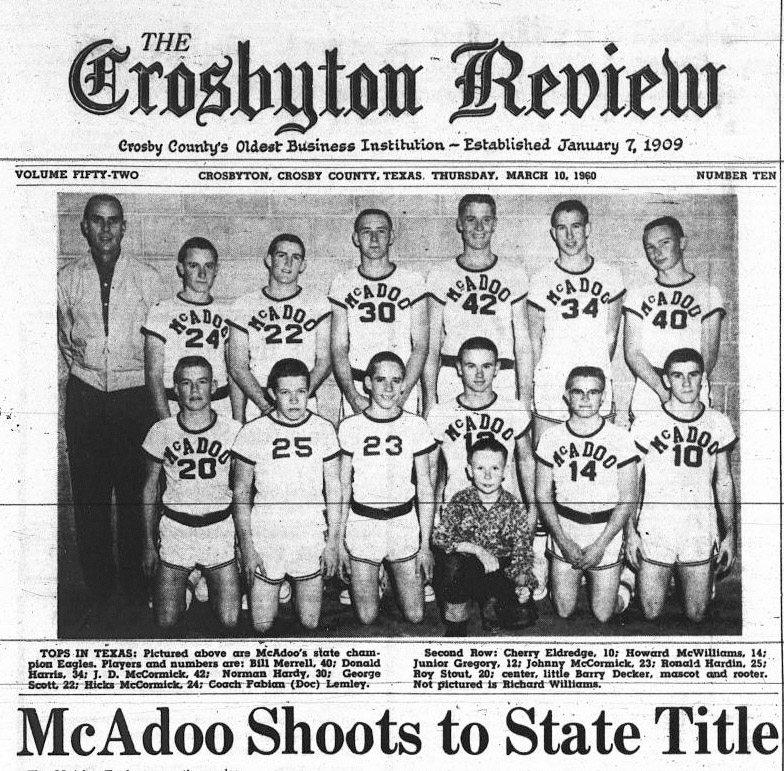
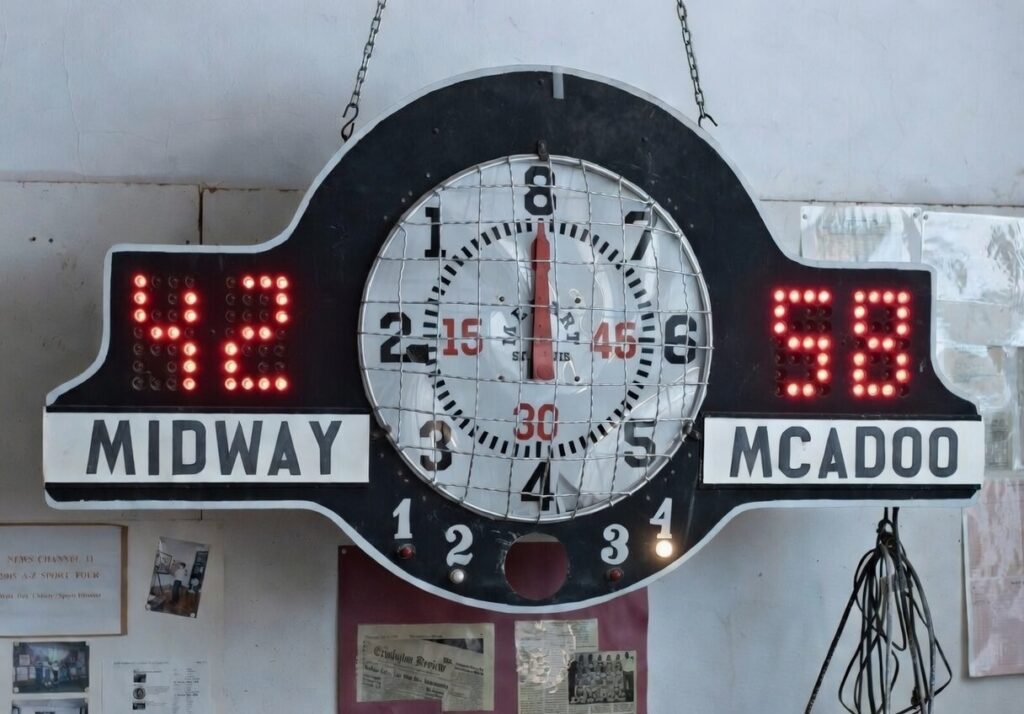
The McAdoo Eagles won state championships in 1960 (d. Henrietta Midway, 58-42), ’63 (d. Nocona Prairie Valley, 53-35) and ’64 (d. Hutto in a nail-biter, 66-65).
Bub’s coaching responsibilities at McAdoo began with scouting for the 1960 championship season. “Now you just take a film and you study it, run it, you know, back and forth. We didn’t have film then. I’d go down there and watch them play, and write it on a piece of paper what you thought they were doing, you know.”
In addition to their state championship, the ’60 season also included a 43-point game by George Scott (wearing #22 in the photo below), an incredible performance achieved decades before the 3-point line was introduced. This conference record for highest score in a tournament game, shared with John Ray Godfrey of Aspermont in 1962, still stands today, more than 60 years later.
Principal Eldredge
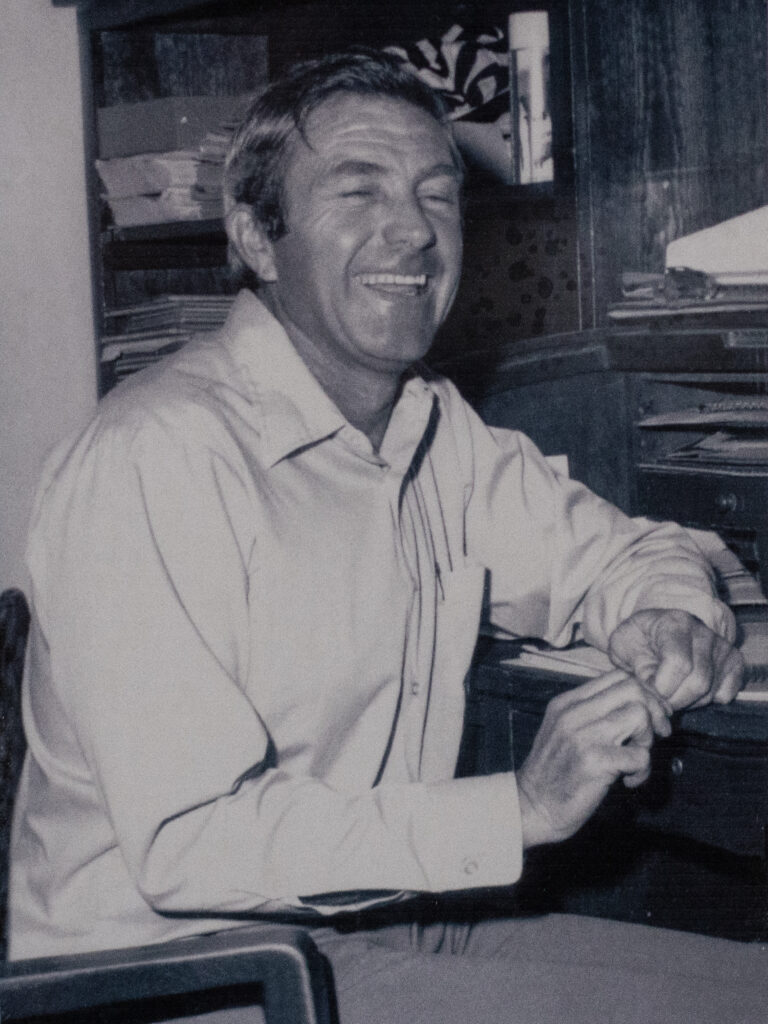
Bub would stay on at McAdoo, coaching and teaching. He was appointed principal in 1966, a post he held until the school’s closure in 1985.
“Up here at McAdoo, I taught driver’s ed. You know all the kids here, they can drive in the country time they’re 10 years old. [No kidding.] Yeah. So what we did during driver’s ed, we went around and checked my cows. So then all those kids still remember it. [That’s funny.] You know, driving the pasture, checking the water.
And on Friday, if they were pretty good, we’d go to Dickens. They had a pharmacy down there, fountain drinks, you know, and they’d save their money up and they’d, I’d make ’em buy me a drink, you know. [That’s a good deal right there.] You know, it was probably 25 cents. You know, up here at McAdoo, it was 5 cents, Coke. Popcorn was, I guess a nickel. But then if I had a date, you know, we’d take $2. To go to Crosbyton and a movie. I think it cost a quarter to get in. And 10 cents for popcorn, and 10 for a Coke, and had money left.”
Family Life
“I got married in ’70, I guess” Bub told me. “We bought this place. Four hundred acres and don’t ask me how I bought it” he said, which is West Texas gentlemanly code speak for downplaying one’s own achievements. Like with his basketball success at Clarendon College, where “believe it or not,” as he described it, they won the conference championship. Or when he told me how he and his wife Mary “accidentally scraped up two thousand” to buy their first house.
Now, you might be wondering how it was possible to buy a house–not just the down payment, but the entire purchase price–for just $2,000. I mean, this was 1970 and things were cheaper, but they certainly weren’t that cheap. So, as someone from Bub’s generation (and mine too, still) might ask: What gives?
“It’s in the middle of the road.”
To turn their acreage into a homestead, Bub and Mary needed, well, a home. As serendipity would have it, an opportunity soon presented itself.
Nearby, the Texas Highway Department (“TxDOT” since 1991) had a road-widening project underway–one of many that spawned across rural Texas in the wake of the Federal Aid Highway Act of 1956. Properties in the path of construction were bought up, and their houses scheduled for demolition–unless that is, the owner acted quickly, before the bulldozers arrived.
According to the highway department’s policy on “owner retention of improvements,” seller’s were generally allowed to buy back the structure for “salvage value”–normally 10% of the state’s purchase price–in order to move, re-sell or dispose of it as they wished, before demolition began.[5]The Federal Aid Highway Act of 1956, Eisenhower’s sweeping legislation that created the Interstate Highway System, triggered a cascade of road-widening and right-of-way acquisition across the … Continue reading
Bub will take it from here:
This house was a mile down the road. And they put this four lane road in. And the guy, they gave him $20,000 for it. And he could buy it back for what, 10%, or $2,000. He bought it back. And then he thought he could sell it. Then he couldn’t sell it because it had to be cut in two because it’s “L”-shaped…the house had to be cut in two, to move it. [Oh, okay] It sat right in the middle of the highway. [Oh. So, okay. So they were gonna put the road through, but the house was there] Right in the middle of the road.
And they bought the house from the guy, give him $20,000. And he bought it back for $2,000. And he thought he’d make money. But everybody couldn’t get a loan on it because the house was too old. So he come to me and he said, ‘I’ll sell it to you for $2,000, just what it cost me.’ Of course, where was $2,000 coming from? I didn’t have it. So we accidentally scraped up $2,000 and bought it.
I went to FHA. [Yeah] And I said ‘I bought a house.’ [Mm-hmm] And, uh…and I said, ‘It’s in the middle of the road.’ And I, I knew the guy, John Quattlebaum. [Okay] And he, and he said, ‘Uh, we’ll see’ [Wait, wait, wait. What…what did they say when you told him the house is in the middle of the road?] He said, he said, ‘What are you going to do?’ I said, ‘I come to see you and get the money to move it.’ And so he, uh, it wasn’t a week later, he called me. He said, ‘I got some money for you.’ [Yeah. That’s pretty quick.]
So borrowed $6,000. [Okay] $2,000 to move it, [Right] $2,000 for foundation, [Uh-huh] $2,000 to put it together and, and run the porch on it. $6,000. [There you go…that’s a pretty good deal.] $50 a month payment. [Nice.]
That house is the one Bub and Mary still live in today. They raised their two daughters there, making additions and improvements as the family grew. The Eldredge daughters would later graduate from Texas Tech, and go on to careers in business and nursing.
The house itself, once condemned to demolition, rescued for $2,000, cut in two, hauled down a dusty road and reassembled, transformed their acreage into a homestead. For the Eldredges, and for at least one other family before the move, this house has been providing shelter from the hot and cold winds of West Texas for well over half a century. And counting.
Crosbyton Chiefettes
After McAdoo, Bub spent the next several years teaching at Crosbyton, and coaching the Crosbyton Chiefettes girls basketball team to their first-ever tournament win.
“So, that job come open over at Crosbyton. And they’d never won a game, period, the girls–I just coached girls over there. So, we had the “Little Dribblers”[6]The Little Dribblers Bub refers to is a youth basketball program, focused on player development, and founded in nearby Levelland, in 1969. back then, so I had a pretty good bunch of kids coming up. And then [after the McAdoo closure], some of them come to Crosbyton, some of them went to Spur.
I always told them, I brought the smart ones to Crosbyton, and the…the others went to Spur. But anyway, that’s the way it happened. And we had good years over there at Crosbyton. They’d never won a tournament in their whole life, had the girls. That’s hard to believe. You know, you enter somewhere, you’re gonna win.”
More to come…
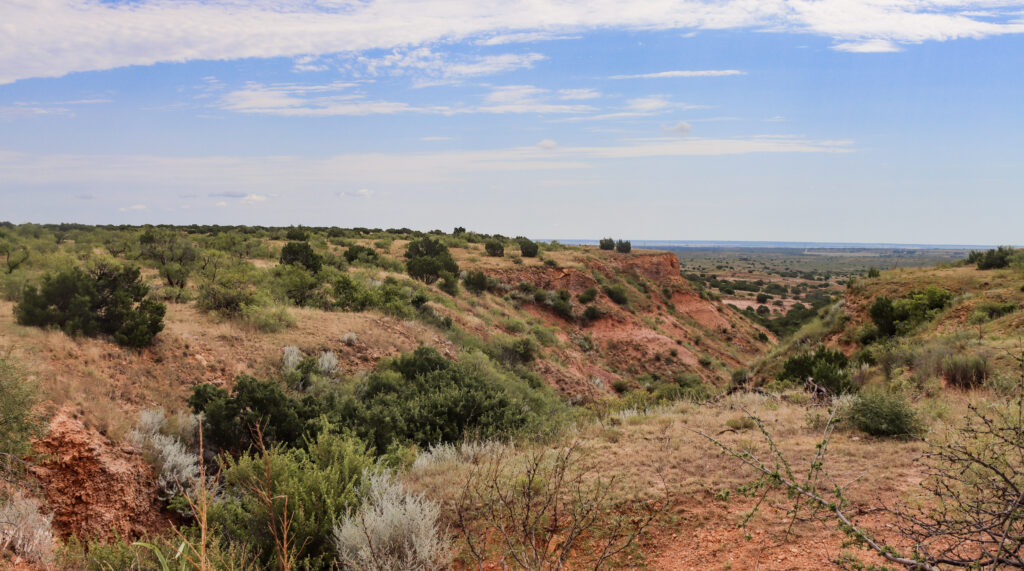
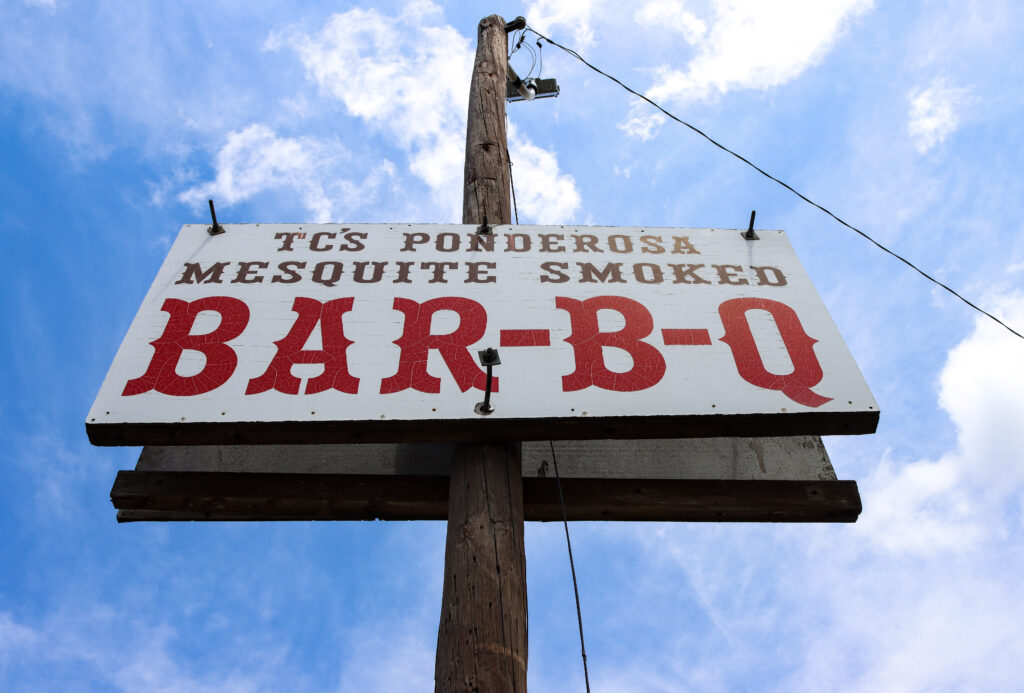
In the meantime, and while you’re out this way, the red rock breaks and scenery here in Dickens County are worth slowin’ down for, and TCs Ponderosa will take care of you for lunch–brisket or pulled pork, with pickled jalapenos, fresh onions and iced tea–you know the drill.
References
| ↑1 | For more information on McAdoo schools and Dickens county, please refer to the Dickens County Historical Commission. |
|---|---|
| ↑2 | For more information, contact the McAdoo School Historical Society, at P.O. Box 86, McAdoo, TX, 79243 |
| ↑3 | High schools that have matched or exceeded McAdoo’s 3-in-5 performance include: Bowie/Tucker, Buna, Kimball, Kountze, Krum, Morton, Nazareth, Port Arthur Lincoln, and Snook. Sources: UIL State Boys Basketball Champions; UIL State Basketball Records. |
| ↑4 | For a deeper dive into the glorious tradition of Texas sports writing, the logical starting point is Blackie Sherrod—16-time Texas Sportswriter of the Year and, by wide consensus, the dean of the craft, anthologized in The Blackie Sherrod Collection (1988) and Blackie Sherrod at Large (2002). Sherrod mentored a remarkable generation including Dan Jenkins, Bud Shrake, and Gary Cartwright—collectively known as “Blackie’s Boys.” Jenkins’s I’ll Tell You One Thing: The Untold Truth About Texas, America & College Football (1999) offers a characteristically irreverent look at the tradition, while Cartwright’s Confessions of a Washed-Up Sportswriter (1982) remains the most reflexive account of the craft itself—its excesses, its pleasures, and its vanishing world. |
| ↑5 | The Federal Aid Highway Act of 1956, Eisenhower’s sweeping legislation that created the Interstate Highway System, triggered a cascade of road-widening and right-of-way acquisition across the country, including rural Texas. For current TxDOT policies, see : TxDOT Right of Way Acquisition Manual, Chapter 5, Section 8 and also the ROW Appraisal Manuall |
| ↑6 | The Little Dribblers Bub refers to is a youth basketball program, focused on player development, and founded in nearby Levelland, in 1969. |