The parcel size of 160 acres provides insight into the settlement and the future of the American West. In 1862, the federal Homestead Act set the standard allotment at one quarter section (160 acres), a size considered large enough to support a family homestead.
That size made sense—if you were to the east of the 100th meridian, the north-south line that cuts Texas and the continent roughly in half, and divides the verdant east, from the arid west (see precipitation map below). West of the line, rainfall is scarce and crops are thin, and 160 acres was a setup for failure. Here, a family needs far more than a quarter section to grow enough food and graze enough cattle to survive.
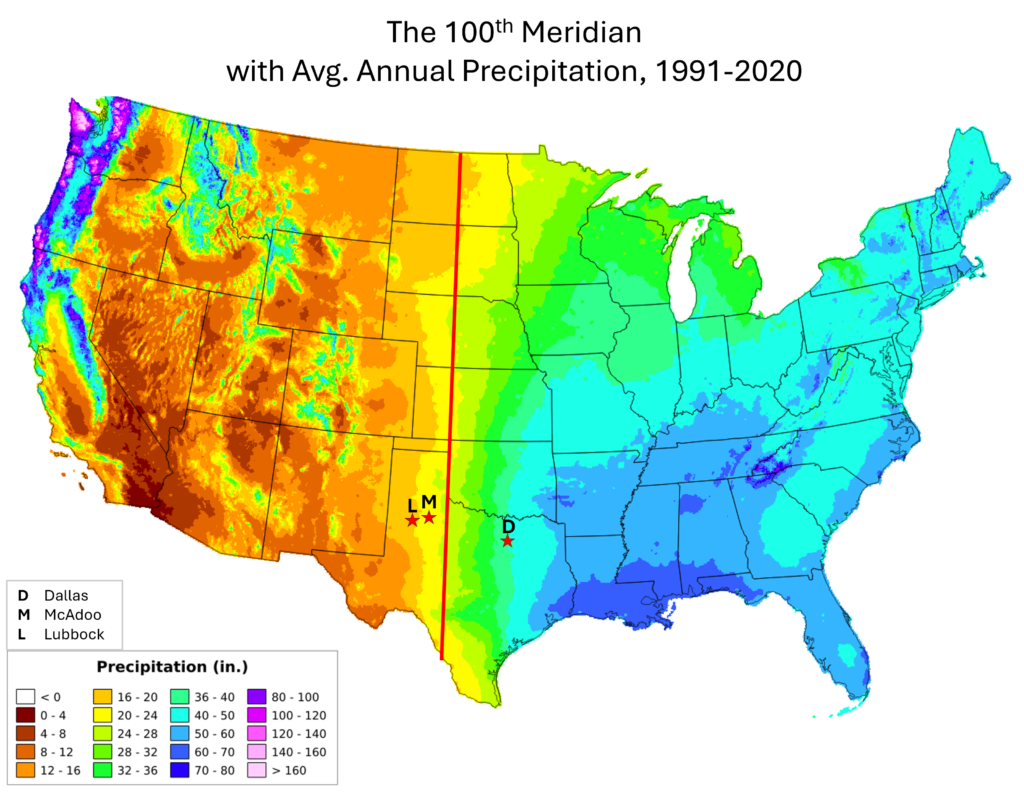
Explorer and geologist John Wesley Powell was the first to call our attention to the significance of the 100th meridian, also known as the “rain line.” In his landmark report to congress in 1878, he argued for a minimum allotment of four full sections, or 2,560 acres–sixteen times the Homestead standard–for viable settlement of the west. Powell lost that argument, at least in the first round. But the fight over usage, aquifers, and water rights, is far from settled.
So watch carefully Fellow Travelers, because on your way from Dallas to Lubbock, you’ll cross over this line of demarcation on Highway 114, just west of Benjamin, and about an hour before arriving at Bub’s place. As you cross over, and look out at the landscape, I think it will make a lot more sense why Bub marvels at what the Gollihars and others were able to achieve out here, with only the power of horses and mules, and why I marvel at what Bub and the ranchers and farmers of this area continue to achieve every day.
Click below to return to: